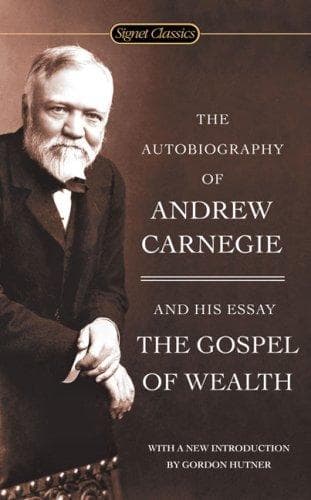
Carnegie, Andrew, 1835-1919; Industrialists -- United States -- Biography; Philanthropists -- United States -- Biography
The young man is soon in chronic rebellion, trying to assume godliness
with the others, acquiescing outwardly in the creed and all its
teachings, and yet at heart totally unable to reconcile his outward
accordance with his inward doubt. If there be intellect and virtue in
the man but one result is possible; that is, Carlyle's position after
his terrible struggle when after weeks of torment he came forth: "If
it be incredible, in God's name, then, let it be discredited." With
that the load of doubt and fear fell from him forever.
When I, along with three or four of my boon companions, was in this
stage of doubt about theology, including the supernatural element, and
indeed the whole scheme of salvation through vicarious atonement and
all the fabric built upon it, I came fortunately upon Darwin's and
Spencer's works "The Data of Ethics," "First Principles," "Social
Statics," "The Descent of Man." Reaching the pages which explain how
man has absorbed such mental foods as were favorable to him, retaining
what was salutary, rejecting what was deleterious, I remember that
light came as in a flood and all was clear. Not only had I got rid of
theology and the supernatural, but I had found the truth of evolution.
"All is well since all grows better" became my motto, my true source
of comfort. Man was not created with an instinct for his own
degradation, but from the lower he had risen to the higher forms. Nor
is there any conceivable end to his march to perfection. His face is
turned to the light; he stands in the sun and looks upward.
Humanity is an organism, inherently rejecting all that is deleterious,
that is, wrong, and absorbing after trial what is beneficial, that is,
right. If so disposed, the Architect of the Universe, we must assume,
might have made the world and man perfect, free from evil and from
pain, as angels in heaven are thought to be; but although this was not
done, man has been given the power of advancement rather than of
retrogression. The Old and New Testaments remain, like other sacred
writings of other lands, of value as records of the past and for such
good lessons as they inculcate. Like the ancient writers of the Bible
our thoughts should rest upon this life and our duties here. "To
perform the duties of this world well, troubling not about another, is
the prime wisdom," says Confucius, great sage and teacher. The next
world and its duties we shall consider when we are placed in it.
I am as a speck of dust in the sun, and not even so much, in this
solemn, mysterious, unknowable universe. I shrink back. One truth I
see. Franklin was right. "The highest worship of God is service to
Man." All this, however, does not prevent everlasting hope of
immortality. It would be no greater miracle to be born to a future
life than to have been born to live in this present life. The one has
been created, why not the other? Therefore there is reason to hope for
immortality. Let us hope.[75]
Public-domain text, read in full here on John Shaqi.
Reviews
Reviews
No reviews yet
Be the first to share your thoughts on this work.
Elsewhere in the archive
Join the Discussion
Join the discussion
Sign in to leave a comment or review.
Sign InorCreate an account