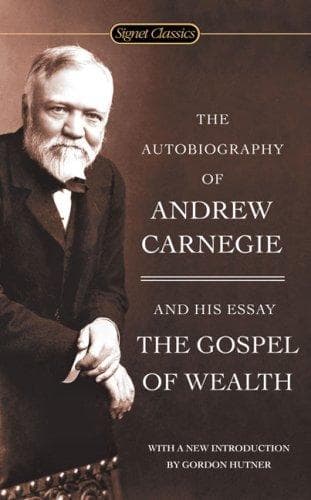
Carnegie, Andrew, 1835-1919; Industrialists -- United States -- Biography; Philanthropists -- United States -- Biography
John Hay was our frequent guest in England and Scotland, and was on
the eve of coming to us at Skibo in 1898 when called home by President
McKinley to become Secretary of State. Few have made such a record in
that office. He inspired men with absolute confidence in his
sincerity, and his aspirations were always high. War he detested, and
meant what he said when he pronounced it "the most ferocious and yet
the most futile folly of man."
The Philippines annexation was a burning question when I met him and
Henry White (Secretary of Legation and later Ambassador to France) in
London, on my way to New York. It gratified me to find our views were
similar upon that proposed serious departure from our traditional
policy of avoiding distant and disconnected possessions and keeping
our empire within the continent, especially keeping it out of the
vortex of militarism. Hay, White, and I clasped hands together in
Hay's office in London, and agreed upon this. Before that he had
written me the following note:
_London, August 22, 1898_
MY DEAR CARNEGIE:
I thank you for the Skibo grouse and also for your kind
letter. It is a solemn and absorbing thing to hear so many
kind and unmerited words as I have heard and read this last
week. It seems to me another man they are talking about,
while I am expected to do the work. I wish a little of the
kindness could be saved till I leave office finally.
I have read with the keenest interest your article in the
"North American."[77] I am not allowed to say in my present
fix how much I agree with you. The only question on my mind
is how far it is now _possible_ for us to withdraw from the
Philippines. I am rather thankful it is not given to me to
solve that momentous question.[78]
[Footnote 77: The reference is to an article by Mr. Carnegie in the
_North American Review_, August, 1898, entitled: "Distant
Possessions--The Parting of the Ways."]
[Footnote 78: Published in Thayer, _Life and Letters of John Hay_,
vol. II, p. 175. Boston and New York, 1915.]
It was a strange fate that placed upon him the very task he had
congratulated himself was never to be his.
He stood alone at first as friendly to China in the Boxer troubles and
succeeded in securing for her fair terms of peace. His regard for
Britain, as part of our own race, was deep, and here the President was
thoroughly with him, and grateful beyond measure to Britain for
standing against other European powers disposed to favor Spain in the
Cuban War.
Public-domain text, read in full here on John Shaqi.
Reviews
Reviews
No reviews yet
Be the first to share your thoughts on this work.
Elsewhere in the archive
Join the Discussion
Join the discussion
Sign in to leave a comment or review.
Sign InorCreate an account