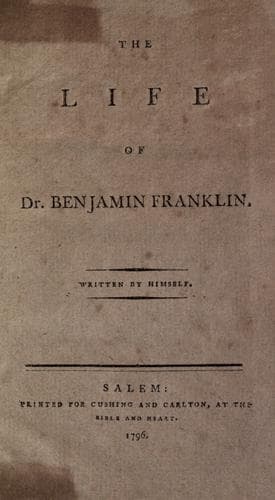
Autobiography of Benjamin FranklinFranklin, Benjamin
History
Autobiography of Benjamin Franklin
Franklin, Benjamin
Franklin, Benjamin, 1706-1790; Statesmen -- United States -- Biography
These twenty parcels, well pack'd, were placed on as many horses, each
parcel, with the horse, being intended as a present for one officer.
They were very thankfully receiv'd, and the kindness acknowledg'd by
letters to me from the colonels of both regiments, in the most
grateful terms. The general, too, was highly satisfied with my conduct
in procuring him the waggons, etc., and readily paid my account of
disbursements, thanking me repeatedly, and requesting my farther
assistance in sending provisions after him. I undertook this also, and
was busily employ'd in it till we heard of his defeat, advancing for
the service of my own money, upwards of one thousand pounds sterling,
of which I sent him an account. It came to his hands, luckily for me,
a few days before the battle, and he return'd me immediately an order
on the paymaster for the round sum of one thousand pounds, leaving the
remainder to the next account. I consider this payment as good luck,
having never been able to obtain that remainder, of which more
hereafter.
This general was, I think, a brave man, and might probably have made a
figure as a good officer in some European war. But he had too much
self-confidence, too high an opinion of the validity of regular
troops, and too mean a one of both Americans and Indians. George
Croghan, our Indian interpreter, join'd him on his march with one
hundred of those people, who might have been of great use to his army
as guides, scouts, etc., if he had treated them kindly; but he
slighted and neglected them, and they gradually left him.
In conversation with him one day, he was giving me some account of his
intended progress. "After taking Fort Duquesne,"[97] says he, "I am to
proceed to Niagara; and, having taken that, to Frontenac,[98] if the
season will allow time; and I suppose it will, for Duquesne can hardly
detain me above three or four days; and then I see nothing that can
obstruct my march to Niagara." Having before revolv'd in my mind the
long line his army must make in their march by a very narrow road, to
be cut for them thro' the woods and bushes, and also what I had read
of a former defeat of fifteen hundred French, who invaded the Iroquois
country, I had conceiv'd some doubts and some fears for the event of
the campaign. But I ventur'd only to say, "To be sure, sir, if you
arrive well before Duquesne, with these fine troops, so well provided
with artillery, that place not yet completely fortified, and as we
hear with no very strong garrison, can probably make but a short
resistance. The only danger I apprehend of obstruction to your march
is from ambuscades of Indians, who, by constant practice, are
dexterous in laying and executing them; and the slender line, near
four miles long, which your army must make, may expose it to be
attack'd by surprise in its flanks, and to be cut like a thread into
several pieces, which, from their distance, cannot come up in time to
support each other."
[97] Pittsburg.
Public-domain text, read in full here on John Shaqi.
Reviews
Reviews
No reviews yet
Be the first to share your thoughts on this work.
Elsewhere in the archive
Join the Discussion
Join the discussion
Sign in to leave a comment or review.
Sign InorCreate an account