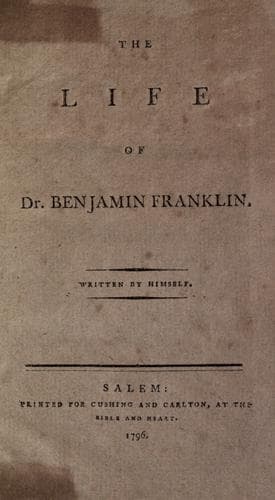
Autobiography of Benjamin FranklinFranklin, Benjamin
History
Autobiography of Benjamin Franklin
Franklin, Benjamin
Franklin, Benjamin, 1706-1790; Statesmen -- United States -- Biography
The waggoners took each a horse out of his team and scamper'd; their
example was immediately followed by others; so that all the waggons,
provisions, artillery, and stores were left to the enemy. The general,
being wounded, was brought off with difficulty; his secretary, Mr.
Shirley, was killed by his side; and out of eighty-six officers,
sixty-three were killed or wounded, and seven hundred and fourteen men
killed out of eleven hundred. These eleven hundred had been picked men
from the whole army; the rest had been left behind with Colonel
Dunbar, who was to follow with the heavier part of the stores,
provisions, and baggage. The flyers, not being pursu'd, arriv'd at
Dunbar's camp, and the panick they brought with them instantly seiz'd
him and all his people; and, tho' he had now above one thousand men,
and the enemy who had beaten Braddock did not at most exceed four
hundred Indians and French together, instead of proceeding, and
endeavouring to recover some of the lost honour, he ordered all the
stores, ammunition, etc., to be destroy'd, that he might have more
horses to assist his flight towards the settlements, and less lumber
to remove. He was there met with requests from the governors of
Virginia, Maryland, and Pennsylvania, that he would post his troops on
the frontier, so as to afford some protection to the inhabitants; but
he continued his hasty march thro' all the country, not thinking
himself safe till he arrived at Philadelphia, where the inhabitants
could protect him. This whole transaction gave us Americans the first
suspicion that our exalted ideas of the prowess of British regulars
had not been well founded.[99]
[99] Other accounts of this expedition and defeat may be
found in Fiske's _Washington and his Country_, or
Lodge's _George Washington_, Vol. 1.
In their first march, too, from their landing till they got beyond the
settlements, they had plundered and stripped the inhabitants, totally
ruining some poor families, besides insulting, abusing, and confining
the people if they remonstrated. This was enough to put us out of
conceit of such defenders, if we had really wanted any. How different
was the conduct of our French friends in 1781, who, during a march
thro' the most inhabited part of our country from Rhode Island to
Virginia, near seven hundred miles, occasioned not the smallest
complaint for the loss of a pig, a chicken, or even an apple.
Captain Orme, who was one of the general's aids-de-camp, and, being
grievously wounded, was brought off with him, and continu'd with him
to his death, which happen'd in a few days, told me that he was
totally silent all the first day, and at night only said, "_Who would
have thought it?_" That he was silent again the following day, saying
only at last, "_We shall better know how to deal with them another
time_"; and dy'd in a few minutes after.
Public-domain text, read in full here on John Shaqi.
Reviews
Reviews
No reviews yet
Be the first to share your thoughts on this work.
Elsewhere in the archive
Join the Discussion
Join the discussion
Sign in to leave a comment or review.
Sign InorCreate an account