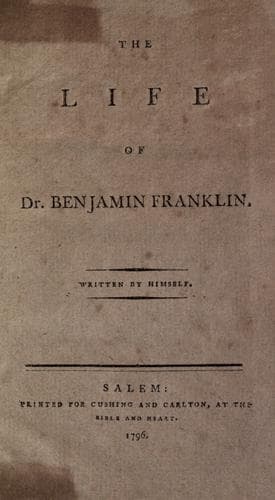
Autobiography of Benjamin FranklinFranklin, Benjamin
History
Autobiography of Benjamin Franklin
Franklin, Benjamin
Franklin, Benjamin, 1706-1790; Statesmen -- United States -- Biography
I saw afterwards in London Captain Bonnell, who commanded one of those
packets. He told me that, when he had been detain'd a month, he
acquainted his lordship that his ship was grown foul, to a degree that
must necessarily hinder her fast sailing, a point of consequence for a
packet-boat, and requested an allowance of time to heave her down and
clean her bottom. He was asked how long time that would require. He
answered, three days. The general replied, "If you can do it in one
day, I give leave; otherwise not; for you must certainly sail the day
after to-morrow." So he never obtain'd leave, though detained
afterwards from day to day during full three months.
I saw also in London one of Bonnell's passengers, who was so enrag'd
against his lordship for deceiving and detaining him so long at New
York, and then carrying him to Halifax and back again, that he swore
he would sue him for damages. Whether he did or not, I never heard;
but, as he represented the injury to his affairs, it was very
considerable.
On the whole, I wonder'd much how such a man came to be intrusted[114]
with so important a business as the conduct of a great army; but,
having since seen more of the great world, and the means of obtaining,
and motives for giving places, my wonder is diminished. General
Shirley, on whom the command of the army devolved upon the death of
Braddock, would, in my opinion, if continued in place, have made a
much better campaign than that of Loudoun in 1757, which was
frivolous, expensive, and disgraceful to our nation beyond conception;
for, tho' Shirley was not a bred soldier, he was sensible and
sagacious in himself, and attentive to good advice from others,
capable of forming judicious plans, and quick and active in carrying
them into execution. Loudoun, instead of defending the colonies with
his great army, left them totally expos'd while he paraded idly at
Halifax, by which means Fort George was lost, besides, he derang'd all
our mercantile operations, and distress'd our trade, by a long embargo
on the exportation of provisions, on pretence of keeping supplies from
being obtain'd by the enemy, but in reality for beating down their
price in favour of the contractors, in whose profits, it was said,
perhaps from suspicion only, he had a share. And, when at length the
embargo was taken off, by neglecting to send notice of it to
Charlestown, the Carolina fleet was detain'd near three months longer,
whereby their bottoms were so much damaged by the worm that a great
part of them foundered in their passage home.
[114] This relation illustrates the corruption that
characterized English public life in the eighteenth
century. (See page 308). It was gradually overcome in
the early part of the next century.
Public-domain text, read in full here on John Shaqi.
Reviews
Reviews
No reviews yet
Be the first to share your thoughts on this work.
Elsewhere in the archive
Join the Discussion
Join the discussion
Sign in to leave a comment or review.
Sign InorCreate an account