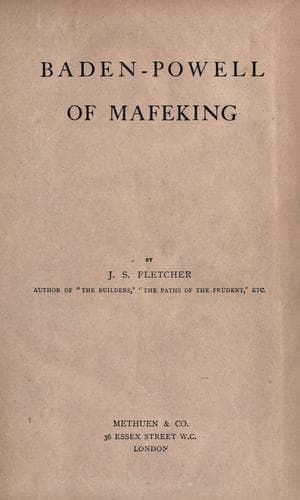
Baden-Powell of MafekingFletcher, J. S. (Joseph Smith)
History
Baden-Powell of Mafeking
Fletcher, J. S. (Joseph Smith)
Baden-Powell of Gilwell, Robert Stephenson Smyth Baden-Powell, Baron, 1857-1941; Generals -- Great Britain -- Biography
Not only food, but money was running short in Mafeking now, and
the ingenious brain of its commander was called upon to supply
the deficiency. He instituted a paper currency for sums as low as
threepence, and also issued bank-notes for £1 and £5. The postage
stamps becoming exhausted, a new supply, stamped with the words
"Mafeking Besieged," was produced. However short the money supply
was, however, it seems to have made little difference to people who
wished to spend it, since one hears of unexploded shells being sold as
curiosities for as much as twelve guineas each.
In his despatch of March 27th, Baden-Powell, after beginning with
the familiar "All Well," which sounds so strange to folk who were
wondering how Mafeking was contriving to hold out as she did, goes
on to say that they are experiencing the hottest shelling of the
siege, but that the town was comparatively free from musketry fire.
The Boers, in fact, were being steadily pushed back, the besiegers
never losing an opportunity of advancing their trenches nearer to the
enemy's position, and the latter were also worried by the advance of
Colonel Plumer's relief column. On March 31st, heavy firing was heard
to the northward of the town, and the enemy were seen to be going in a
northerly direction in great haste, taking three field guns with them.
The garrison at once opened fire on their forts, and continued it until
the firing northward ceased. Next morning General Snyman sent a message
to Baden-Powell requesting him to send out an ambulance to bring in the
dead of Colonel Plumer's force, who, according to his version, had been
slain by hundreds. When the ambulance reached the scene of operation,
three bodies were discovered.
About the beginning of April, General Snyman was relieved of his
command, in which he had had no more success than the redoubtable
Cronje, by Commandant Botha. This made no difference to the garrison,
who were determined to hold out two months longer if necessary. Some
considerable help was given to the commissariat department at this
period by a Scotsman, Mr. Sims, who invented a food called sowan
porridge, made from the husks of oats. This proved very nourishing,
and if not exactly appetizing, was wholesome, and much to be preferred
to nothing when the question of going supperless to bed came on.
A statement prepared by Captain Ryan, head of the commissariat
department, shows how things were going in April:--
"The total number of white men is approximately 1150, of white women
400, and of white children 300. The coloured population consists of
some 2000 men, 2000 women, and 3000 children.
Public-domain text, read in full here on John Shaqi.
Reviews
Reviews
No reviews yet
Be the first to share your thoughts on this work.
Elsewhere in the archive
Join the Discussion
Join the discussion
Sign in to leave a comment or review.
Sign InorCreate an account