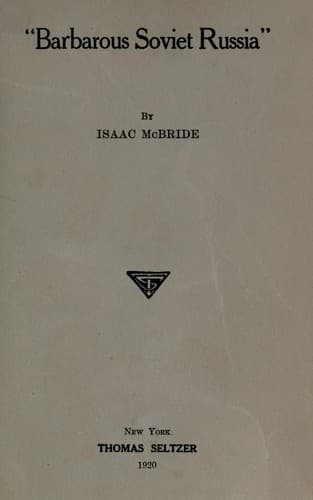
Communism -- Soviet Union; Soviet Union -- Economic conditions -- 1917-1945; Soviet Union -- Politics and government -- 1917-1936
The Murom district, manufacturing cutlery and to some extent also
instruments, has turned out, during the period following the
organization of the government agency, 15 million roubles’ worth of
goods, while the total worth of it, including remnants returned, amounts
to 25 million roubles; the Pavlovsk district engaged in the manufacture
of cutlery, locks and instruments,—among others, surgical
instruments—has produced since October 1st, 1918, 70 million roubles’
worth of merchandise; including the remnants, this would aggregate to
100 million roubles. The Tula district (hardware, locks, stove
accessories, samovars, hunters’ rifles), has produced since May 1919, 30
million roubles’ worth of goods, which, including the remnants, amount
to 60 million roubles. The cast-iron foundries of the Kaluga and Ryazan
districts (manufacturing cast-iron utensils, stove accessories and
various other castings) have produced since October 1st, 1918, 50
million roubles’ worth of merchandise, including the remnants.
Thus, the total amount of goods produced amounts to 165 million
roubles,—or to 235 million roubles, if the value of the remnants is
added,—taking 40 as the co-efficient of its value according to
peace-time prices.
The central administration could not take upon itself the direct
organization of home industries to the full extent. Its best assistants
in this matter are the local institutions of national economy—the
provincial and district metal committees, which have been brought in
close contact with the central administration by the conventions of the
representatives of the district and provincial metal committees. These
conventions were being called at regular intervals for the purpose of
working out and ratifying their programs concerning production and
distribution of metals, and financial questions.
We must also mention the fact that all the measures in the domain of the
metal industry are being carried out with the close and immediate
cooperation of the workers’ producing association—the union of metal
workers.
Thus, as has been proven from practical experience, the methods and
forms of organization of the metal industry have turned out to be
correct. Their application is therefore to be continued and widened,
strengthening the ties binding these organizations with the local
administrative bodies, such as the provincial and district metal
committees and with the central management of the amalgamated
enterprises.
Public-domain text, read in full here on John Shaqi.
Reviews
Reviews
No reviews yet
Be the first to share your thoughts on this work.
Elsewhere in the archive
Join the Discussion
Join the discussion
Sign in to leave a comment or review.
Sign InorCreate an account