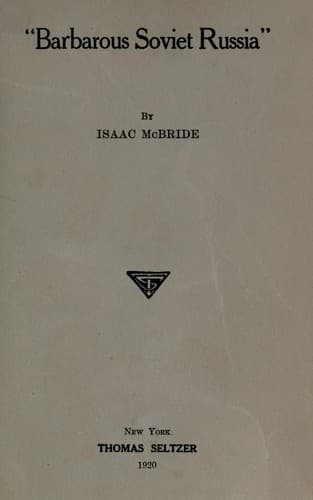
Communism -- Soviet Union; Soviet Union -- Economic conditions -- 1917-1945; Soviet Union -- Politics and government -- 1917-1936
From June 16th to 25th, 1919, during the nine days of its work, the
second All-Russian Congress of Trades Unions solved the fundamental
questions of the Russian professional (trades union) movement. The
Conference more precisely defined the place of the professional trades
unions in a proletarian state, it has more concretely outlined the
interrelations of the trades unions with the organs of administration
and, above all, with the People’s Commissariat of Labor. All other
questions, such as the regulation of working hours and wages, the
safeguarding of labor and the social insurance of laborers, the
organization of production, and workmen’s control have been solved on
the basis of the experience of the past year.
The Russian professional unions entered upon a new era of proletarian
activity. And the unions are already facing practical problems—to put
into practice the principles and resolutions adopted and in all phases
of its work to follow one direction, that of still further strengthening
its power, and participating more closely in establishing the might of
proletarian Russia.
THE PROBLEMS OF THE PROFESSIONAL TRADES UNIONS
(_A resolution introduced by M. Tomsky_)
One year of political and economic dictatorship of the proletariat and
the growth of the workers’ revolution the world over, have fully borne
out the correctness of the position taken by the first All-Russian
Conference of the Professional Trades Unions, who have unconditionally
bound up the fate of the economically organized proletariat with that of
the Workers’ and Peasants’ Government.
The attempt, under the flag of “unity” and “independence” of the trades
union movement, to pit the economically organized proletariat against
the organs of the political dictatorship of its own class, has led the
groups which were supporting this slogan, to an open struggle against
the Soviet Government and has placed them outside the ranks of the
working class.
In the course of the practical cooperation with the Soviet Government in
the work for the strengthening and organization of the nation’s economic
life, the professional trades unions have passed from control over
industry to organization of industry, taking an active part in the
management of individual enterprises as well as in the entire economic
life of the country.
But the task of nationalization of all the means of production and the
organization of society on the new principles of Socialism demands
persistent and careful labor involving the reconstruction of the entire
governmental apparatus, the creation of new organs of control, and
regulation of production and distribution, based on the organization and
activity of the laboring masses who are themselves directly interested
in the results.
Public-domain text, read in full here on John Shaqi.
Reviews
Reviews
No reviews yet
Be the first to share your thoughts on this work.
Elsewhere in the archive
Join the Discussion
Join the discussion
Sign in to leave a comment or review.
Sign InorCreate an account