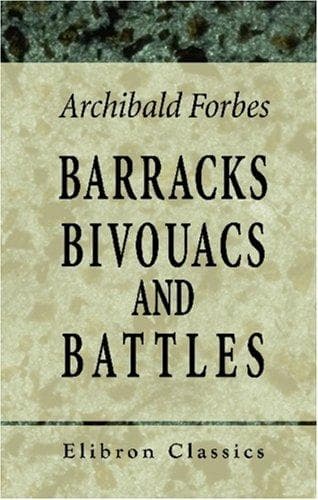
For better or for worse, the war correspondent, as regards a British
army in the field, has been stamped out. The journalist who now
accompanies an army is a war reporter. He dances in the fetters of the
censorship, whose power over him is absolute: it may not only detain
or withhold his work, but at discretion may alter it so that he may
be made to say the direct reverse of what he wrote. If the position
has its humiliations, it also has its compensations. The censorship
which makes a slave of the war reporter, _ipso facto_ relieves him
of all the responsibility for the words he writes. His waking hours
are unclouded by forebodings of aspersions on his veracity, emanating
from officials chafing under inconvenient interpellations. His
slumbers are disturbed by no dream-vision of a bad quarter of an hour
with the chief of staff, when the paper containing that outspoken
telegram of his arrives in camp. The authorities in Pall Mall, by the
institution of the rules and the censorship, have indeed scotched the
war journalist, but have not succeeded in killing him. Lord Wolseley
in the early editions of the _Soldier’s Pocket-book_ described the war
correspondent of the unreformed era as “the curse of modern armies”;
that somewhat strenuous expression he retains in the latest edition
as still applicable to the reporter who works under the yoke of the
regulations set forth in its pages. I may humbly venture to remark,
having given the matter considerable attention, that from the military
point of view I entirely concur in Lord Wolseley’s objections to the
presence of journalistic persons with an army in the field against a
civilised enemy. Were I a general, and had I an independent command
in war offered me, I should accept it only on condition that I should
have the charter to shoot every war correspondent found within fifty
miles of my headquarters. The most careful correspondent cannot write
a sentence--a sentence which the strictest censor, if he is to pass
anything at all, cannot refrain from sanctioning--that may not give a
hint to the astute intelligence-officials of the other side. This fact
I realised at the beginning of my career, and my conviction of its
truth grew till the end of it. What then? It is not a question for the
newspapers, which dread a war because of the huge expense it entails
without adequate compensation. It is a question solely for the public,
whose servants the general and the war journalists alike are. If the
public deliberately prefers news to victories--for that is the issue in
a nutshell as regards a European war--then on the head of the public be
it.
Public-domain text, read in full here on John Shaqi.
Reviews
Reviews
No reviews yet
Be the first to share your thoughts on this work.
Elsewhere in the archive
Join the Discussion
Join the discussion
Sign in to leave a comment or review.
Sign InorCreate an account