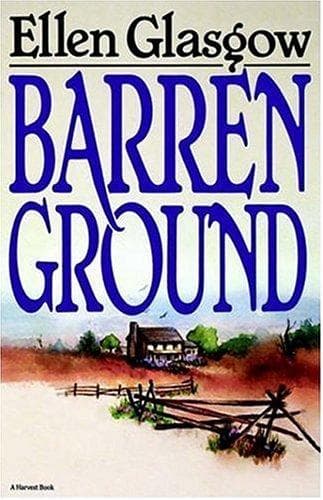
Country life -- Fiction; Pastoral fiction; Piedmont (U.S. : Region) -- Fiction; Virginia -- Fiction
"No, I'd better go back."
They walked to the house in silence, and she scarcely heard him when he
said, "Good night," at the porch.
"I hope you'll find your father better."
"Yes, I hope I'll find him better."
"If there's anything I can do, let me know."
"If there is, I'll let you know."
As he stepped into his buggy, he turned and called out, "I'll try to get
word to the hands to-night, and send them over the first thing in the
morning."
What hands? What did they matter? What did anything matter? It seemed to
her suddenly that, not only her love for Jason, but everything, the
whole of life, was a mistake. Even her best endeavours, even her return
to the farm--"It might have been better if I'd decided differently," she
thought wearily; but when she tried to be definite, to imagine some
other decision she might have made, nothing occurred to her. Something?
But what? Where? She saw no other way, and she felt blindly that she
should never see one.
"I'm tired," she thought, "and this makes me weak. Weakness doesn't help
anything." For an instant this thought held her; then it occurred to her
that, in the years to come, she would be continually tired; and that,
tired or not, she must fight against weakness. "I've got to go straight
ahead, no matter how I feel."
VIII
"Ebenezer Green?"
"Dat's me."
"Peter Plumtree?"
"Dat's me."
"Toby Jackson?"
"Dat's me, Miss D'rindy."
"Rapidan Finley?"
"Dat's me."
She was calling the names of the field hands, and while she went over
the list, her mind was busily assorting and grouping the faces before
her. Yes, she knew them all. Ever since she could remember they had been
a part of the country; she had passed them in the road every week, or
seen them in the vegetable patches in front of their cabins. Like her
mother, she was endowed with an intuitive understanding of the negroes;
she would always know how to keep on friendly terms with that immature
but not ungenerous race. Slavery in Queen Elizabeth County had rested
more lightly than elsewhere. The religion that made people hard to
themselves, her mother had often pointed out, made them impartially just
to their dependents; and like most generalizations, this one was elastic
enough to cover the particular instance. It was true that the coloured
people about Pedlar's Mill were as industrious and as prosperous as any
in the South, and that, within what their white neighbours called
reasonable bounds, there was, at the end of the nineteenth century,
little prejudice against them. Here and there a thriftless farmer, such
as Ike Pryde or Adam Snead, would display a fitful jealousy of Micajah
Green, who had turned a few barren acres into a flourishing farm; but
the better class of farmers preferred the intelligent coloured neighbour
to the ignorant white one. Both were social inferiors; but where the
matter was one solely of farming, the advantages would usually fall to
the more diligent. As for the negroes themselves, they lived contentedly
Public-domain text, read in full here on John Shaqi.
Reviews
Reviews
No reviews yet
Be the first to share your thoughts on this work.
Elsewhere in the archive
Join the Discussion
Join the discussion
Sign in to leave a comment or review.
Sign InorCreate an account