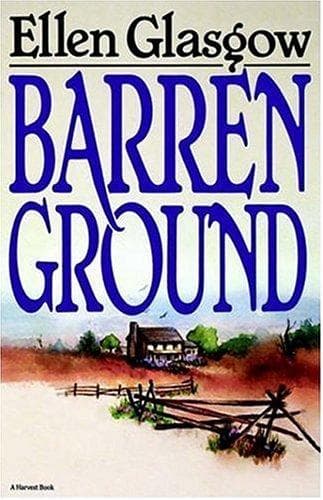
Country life -- Fiction; Pastoral fiction; Piedmont (U.S. : Region) -- Fiction; Virginia -- Fiction
"Yes, that's the trouble about getting comforts. We always remember that
other people went without them. I've got the carpets now that Rose Emily
wanted." After all, no one but Nathan had ever really understood her.
With the thought she asked herself incredulously if understanding had
anything whatever to do with love? Did people who loved ever understand?
Wasn't the misunderstanding even a part of love's divine madness?
"Yes, I ought to have done it long ago," she murmured inattentively.
"I'll order one, if you want me to. There's a catalogue at the store,
and I can get it at a discount. There are all sorts of contrivances for
saving fuel, too, so it won't cost as much as you'd imagine. These
newfangled stoves give twice as much heat as an open fire, and don't
burn one fourth as much fuel. It's a close sort of heat. You wouldn't
like it in your chamber, but it would be the very thing for this hall."
While they went out of doors together, she meditated upon the fact of
his usefulness. He was always thinking of ways and means to be
comfortable or economical before they occurred to her or to anyone else,
and he had what he called a knack for mending anything that was broken.
He was kind; he was honest in every fibre; he was neat in his appearance
for a farmer; and he was, she reflected cynically, almost emasculate in
his unselfishness. To be sure, he had habits which she disliked; but, as
she told herself with dispassionate realism, one couldn't have
everything. It never occurred to her that these habits might be broken
by marriage, for she was wise enough to perceive that a man's habits are
more firmly rooted than his emotions. What she felt was that in exchange
for his helpfulness she might learn to tolerate the things to which she
objected. What good ever came, she demanded impatiently, of trying to
make any one over? Hadn't her mother tried for forty years to make her
father stop chewing tobacco, and yet it was the last thing that he
relinquished. No, she had few illusions remaining. Though she still told
herself inflexibly that she could never make up her mind to marry
Nathan, she felt, in spite of her will, that the insidious force of
logic was gradually undermining her scruples. She had suffered too much
from love in the past ever to walk again with open eyes into the
furnace. Sex emotion, she repeated grimly, was as dead as a burned-out
cinder in her heart. But respect she could still feel, and a marriage
founded upon respect and expediency might offer an available refuge from
loneliness. As she grew older, the thing she feared most was not death,
not poverty even, but the lonely fireside.
She walked on, disheartened by indecision, and Nathan was obliged to
repeat his question twice before she heard what he was saying.
"Have you thought over what I asked you, Dorinda?" She shook her head.
"There's no use thinking."
Public-domain text, read in full here on John Shaqi.
Reviews
Reviews
No reviews yet
Be the first to share your thoughts on this work.
Elsewhere in the archive
Join the Discussion
Join the discussion
Sign in to leave a comment or review.
Sign InorCreate an account