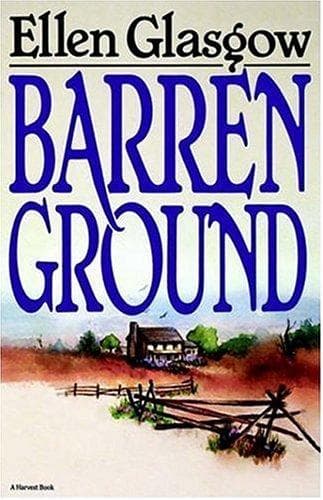
Country life -- Fiction; Pastoral fiction; Piedmont (U.S. : Region) -- Fiction; Virginia -- Fiction
"You look it," the old man agreed, and then, without reason, he sighed.
"Ah, I recollect you thirty years ago, when they used to say you had a
face like a May mornin'. Not that you ain't a fine figure of a woman
now; but as we old men get on in years, our thoughts turn backward and
we like to dwell on young things. Thirty years ago you looked as if
sugar wouldn't melt in yo' mouth."
He drove on regretfully, while Dorinda, on Snowbird, trotted homeward.
The light on the shocked corn was so faint that it waned to a shadow
while she looked at it. A flock of wild geese curved like blown smoke in
the afterglow. Immersed in this twilight as in the sadness of memory,
she gazed at the autumn scene, with the small gold leaves on the locust
trees, the windmill beyond the house, and the flickering of firelight in
the west wing. A prosperous farm to-day, a casual observer would have
remarked; but to Dorinda, who never forgot, the whole place wore the
look of wistful brooding which she remembered whenever she thought of
her father.
Her exultation over Jason's ruinous end had diminished now into an
impersonal pity. She had longed to punish him for his treachery; she had
hated him for years, until she had discovered that hatred is energy
wasted; but in all her past dreams of retribution, she had never once
thought of the poorhouse. Even as a question of justice, it seemed to
her that the poorhouse was excessive. That terror of indigence which is
inherent in self-respecting poverty was deeply bred in her nature, and
she knew that her humbler neighbours were haunted by fear of charity as
one is haunted by fear of smallpox in a pestilence. Yes, whatever he
deserved, the poorhouse was too much. Though the horror of his fate did
not lessen the wrong he had done, by some curious alchemy of imagination
it reduced the sum of human passions to insignificance. What did
anything invisible matter at the gate of the poorhouse?
Though her first impulse, derived from Presbyterian theology, was to
regard his downfall as a belated example of Divine vengeance, her
invincible common sense reminded her that Divine vengeance is seldom so
logical in its judgments. No, he had not ended in the poorhouse because
he had betrayed her. On the contrary, she saw that he had betrayed her
because of that intrinsic weakness in his nature which would have
brought him to disaster even if he had walked in the path of exemplary
virtue. "His betrayal of me was merely an incident," she thought. "Drink
was an incident. If he had been stronger, he might have done all these
things and yet have escaped punishment." For it was not sin that was
punished in this world or the next; it was failure. Good failure or bad
failure, it made no difference, for nature abhorred both. "Poor Jason,"
she said to herself, with contemptuous pity. "He was neither good enough
nor bad enough, that was the trouble."
VIII
Public-domain text, read in full here on John Shaqi.
Reviews
Reviews
No reviews yet
Be the first to share your thoughts on this work.
Elsewhere in the archive
Join the Discussion
Join the discussion
Sign in to leave a comment or review.
Sign InorCreate an account