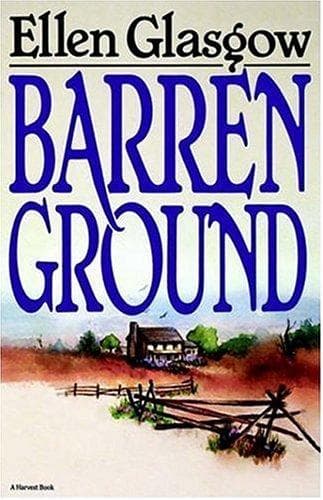
Country life -- Fiction; Pastoral fiction; Piedmont (U.S. : Region) -- Fiction; Virginia -- Fiction
"It looks to me as if they were letting you down," John Abner rejoined
moodily; but his face cleared under her persuasion. After all, what he
liked best was to be treated as an authority not only on farming, but on
human nature as well. The fact that he had lived as a recluse, and knew
nothing whatever of life, did not interfere with the sincerity of his
claim to profound wisdom. Men were so immature, she found herself
thinking; and they were never so immature as when they strutted most
with importance. Since the emotional disaster of her youth, she had been
incapable of either loving or hating without a caustic reservation; and
she felt that the hidden flaw in her relations with men was her
inability to treat a delusion of superiority as if it were a moral
principle. This was a small indulgence, she imagined, to a woman who
loved passionately; but to one who had safely finished with love and
attained the calm judgment of the disillusioned, it was an indulgence
which might prove to be particularly irksome.
Slipping her arm through John Abner's, she walked with him into the
house. "Well, of course, in a way you're right; but after all, even if
they are imposing on us, we couldn't very well refuse to do anything."
Though the two farms would go to John Abner at her death, there were
moments when, notwithstanding his affection for her, she suspected
uncomfortably that he would like complete authority while she was
living. Not that he was ever disagreeable or ungenerous about the way
she managed him. He was, she knew, honestly devoted to her, and he
admired her without the pity that had always tempered her admiration for
him. But he shared, she told herself, with all males who were not
milksops, the masculine instinct to domineer over the opposite sex.
"Well, if it's anybody's business, it's James Ellgood's," he protested.
She raised her straight grey eyebrows with a quizzical smile. "All the
same you can hardly blame James Ellgood for not making it his business.
Nothing will ever let him forget that Jason drove Geneva out of her
mind."
"Well, perhaps he did, but there was no law to punish him."
"That's what James Ellgood feels, of course, and I suppose he is right.
If it were simply a question of punishment----"
"You mean it's more than that?"
"Well, isn't it?" She had learned that she could always win him to her
point of view by disguising a naked fact in the paraphernalia of
philosophy. "From our side, I suppose it's one of humanity." Though she
despised sophistry as heartily as she despised indirectness, she could
bend both to her purpose when it was a matter of compulsion.
"If you mean that our humanity is more important than his punishment?"
he returned in a mollified tone.
"Yes, I do mean that. You have said it so often yourself." That would
finish his opposition, she knew, and without his opposition, life on the
farm would be easier for the next two or three weeks.
"Won't it make a lot of trouble?" he inquired.
Public-domain text, read in full here on John Shaqi.
Reviews
Reviews
No reviews yet
Be the first to share your thoughts on this work.
Elsewhere in the archive
Join the Discussion
Join the discussion
Sign in to leave a comment or review.
Sign InorCreate an account