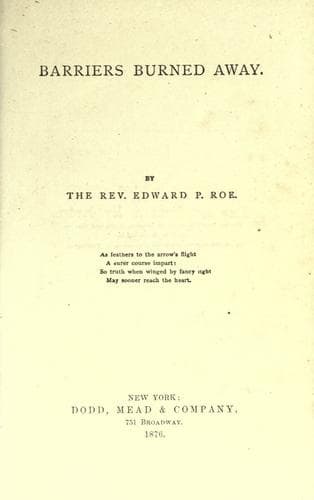
Chicago (Ill.) -- History -- To 1875 -- Fiction; Fires -- Fiction; Great Fire, Chicago, Ill., 1871 -- Fiction; Historical fiction
Some one pushed back the sliding-door a little and passed into the
room. Through the opening he caught a glimpse of the gay scene
within. Suddenly Christine appeared floating lightly through the waltz
in her gauzy drapery, as if in a white, misty cloud. Through the narrow
opening she seemed a radiant, living portrait. But her partner whirled her
out of the line of vision. Thus in the mazes of the dance she kept
appearing and disappearing, flashing in sight one moment, leaving a blank
in the crowded room the next.
"So it will ever be, I suppose," he said to himself, bitterly; "chance
and stolen glimpses my only privilege."
Again she appeared, smiling archly on the man whose arm clasped her
waist.
A frown black as night gathered on Dennis's brow; then a sudden pallor
overspread his face to his very lips. The revelation had come! Then
for the first time he knew--knew it as if written in letters of fire
before him--that he loved Christine Ludolph.
At first the knowledge stunned and bewildered him, and his mind was
a confused blur; then as she appeared again, smiling upon and in the
embrace of another man, a sharp sword seemed to pierce his heart.
Dennis was no faint shadow of a man who had frittered away in numberless
flirtations what little heart he originally had. He belonged to the
male species, with something of the pristine vigor of the first man,
who said of the one woman of all the world, "This is now bone of my
bones, and flesh of my flesh"; and one whom he had first seen but a
few short months since now seemed to belong to him by the highest and
divinest right. But could he ever claim his own?
In his morbid, wearied state, there seemed a "great gulf fixed" between
them. For a moment he fairly felt faint and sick, as if he had received
a wound. He was startled by hearing Miss Winthrop say at his side:
"Mr. Fleet, you will not leave yet. I have many friends wishing an
introduction to you. What is the matter? You look as if you were ill."
At her voice he flushed painfully. He was so vividly conscious of his
love himself that he felt that every one else must be able to see it,
and darkness and solitude now seemed a refuge. Recovering himself by
a great effort he said, "Pardon me, I do--I am not well--nothing is
the matter--a little rest and I shall be myself again."
"No wonder. You have been taxed every way beyond mortal endurance, and
I think that it is a shame the way you have been treated. Pray do not
judge Chicago society altogether by what you have seen here. Let me
get you some refreshment, and then I will acquaint you with some people
who can recognize a gentleman when they meet him."
Public-domain text, read in full here on John Shaqi.
Reviews
Reviews
No reviews yet
Be the first to share your thoughts on this work.
Elsewhere in the archive
Join the Discussion
Join the discussion
Sign in to leave a comment or review.
Sign InorCreate an account