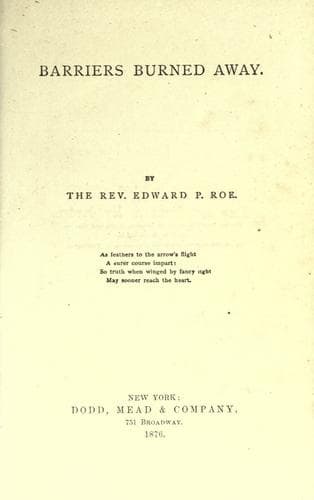
Chicago (Ill.) -- History -- To 1875 -- Fiction; Fires -- Fiction; Great Fire, Chicago, Ill., 1871 -- Fiction; Historical fiction
But at first Dennis scarcely dared to recognize the truth himself, and
the thought of telling even his mother was repugnant. For half an hour
he walked the streets in a sort of stupor. He was conscious only of
a heavy, aching heart and a wearied, confused brain. All the time,
however, he knew an event had occurred that must for good or evil
affect his entire existence; but he shrank with nervous dread from
grappling with the problem. As the cold air refreshed and revived him,
his strong, practical mind took up the question almost without volition,
and by reason of his morbid, wearied state, only the dark and
discouraging side was presented. The awakening to his love was a very
different thing to Dennis, and to the majority in this troubled world,
from the blissful consciousness of Adam when for the first time he saw
the fair being whom he might woo at his leisure, amid embowering roses,
without fear or thought of a rival.
To Dennis the fact of his love, so far from promising to be the source
of delightful romance and enchantment, clearly showed itself to be the
hardest and most practical question of a life full of such questions.
In his strong and growing excitement he spoke to himself as to a second
person: "Oh, I see it all now. Poor, blind fool that I was, to think
that by coveting and securing every possible moment in her presence
I was only learning to love art! As I saw her to-night, so radiant and
beautiful, and yet in the embrace of another man, and that man evidently
an ardent admirer, what was art to me? As well might a starving man
seek to satisfy himself by wandering through an old Greek temple as
for me to turn to art alone. One crumb of warm, manifested love from
her would be worth more than all the cold, abstract beauty in the
universe. And yet what chance have I? What can I hope for more than
a passing thought and a little kindly, condescending interest? Clerk
and man-of-all-work in a store, poor and heavily burdened, the idea
of my loving one of the most wealthy, admired, and aristocratic ladies
in Chicago! It is all very well in story-books for peasants to fall
in love with princesses, but in practical Chicago the fact of my
attachment to Miss Ludolph would be regarded as one of the richest
jokes of the season, and by Mr. Ludolph as such a proof of rusticity
and folly as would at once secure my return to pastoral life."
Then hope whispered, "But you can achieve position and wealth as others
have done, and then can speak your mind from the standpoint of
equality."
Public-domain text, read in full here on John Shaqi.
Reviews
Reviews
No reviews yet
Be the first to share your thoughts on this work.
Elsewhere in the archive
Join the Discussion
Join the discussion
Sign in to leave a comment or review.
Sign InorCreate an account