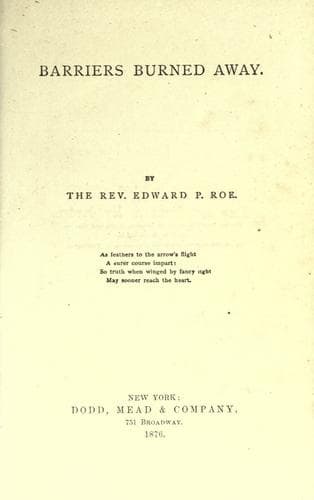
Chicago (Ill.) -- History -- To 1875 -- Fiction; Fires -- Fiction; Great Fire, Chicago, Ill., 1871 -- Fiction; Historical fiction
Dennis had scarcely had time to exclaim at the exquisite loveliness
and finish of the two paintings before Mr. Ludolph entered, accompanied
by Mr. Cornell, a well-known artist, Mr. French, proprietor of another
large picture-store, and several gentlemen of taste, but of lesser
note, whom Dennis had learned to know by sight as habitues of the
"Temple of Art." He also saw that Christine was advancing up the store
with a lady and gentleman. Feeling that his presence might be regarded
as obtrusive, he passed out, and was about to go away, when he heard
his name called.
Looking up he saw Miss Winthrop holding out her hand, and in a moment
more she presented him to her father, who greeted him cordially.
Christine also gave him a brief smile, and said: "You need not go away.
Come and see the pictures."
Quick-eyed Dennis observed that she was filled with suppressed
excitement. Her cheeks, usually but slightly tinged with pink, now by
turns glowed and were pale. Miss Winthrop seemed to share her
nervousness, though what so excited them he could not divine. The
paintings, beautiful as they were, could scarcely be the adequate
cause; and yet every eye was fastened on them.
One seemed the exact counterpart of the other in frame and finish as
well as subject. A little in the background, upon a crag overhanging
the Rhine, was a castle, massive, frowning, and built more for security
and defence than comfort. The surrounding landscape was bold, wild,
and even gloomy. But in contrast with these rugged and sterner features,
was a scene of exquisite softness and tenderness. Beneath the shadow
of some great trees not far from the castle gate, a young crusader was
taking leave of his fair-haired bride. Her pale, tearful face, wherein
love and grief blent indescribably, would move the most callous heart,
while the struggle between emotion and the manly pride that would not
permit him to give way, in the young chieftain's features, was scarcely
less touching. Beautiful as were the accessories of the pictures, their
main point was to portray the natural, tender feeling induced by a
parting that might be forever. At first they all gazed quietly and
almost reverently at the vivid scene of human love and sorrow, save
old Schwartz, who fidgeted about as Dennis had never seen him before.
Clearly something was wrong.
"Mr. Schwartz," said Mr. Ludolph, "you may hang the original picture
on the side as we enter, and the copy opposite. We would like to see
them up, and in a better light."
"Dat's it," snorted Mr. Schwartz; "I'd like to know vich is vich."
"You do not mean to say that you cannot tell them apart? The original
hung here some time, and you saw it every day."
"I do mean to say him," said Mr. Schwartz, evidently much vexed with
himself. "I couldn't have believed dat any von in de vorld could so
impose on me. But de two pictures are just de same to a pin scratch
in frame, subject, and treatment, and to save my life I cannot tell
dem apart."
Public-domain text, read in full here on John Shaqi.
Reviews
Reviews
No reviews yet
Be the first to share your thoughts on this work.
Elsewhere in the archive
Join the Discussion
Join the discussion
Sign in to leave a comment or review.
Sign InorCreate an account