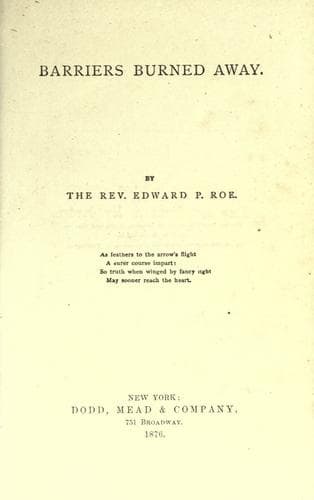
Chicago (Ill.) -- History -- To 1875 -- Fiction; Fires -- Fiction; Great Fire, Chicago, Ill., 1871 -- Fiction; Historical fiction
She justly feared that, should he see her work, he might discover her
plan; for, however she might disguise it, something suggesting himself
entered into all her studies.
"I hope you will succeed, but doubt it."
"Why?" she asked, quickly.
"Because we cannot portray what we cannot feel. The stream cannot rise
higher than its fountain." Then he added, with heightened color and
some hesitation, "I fear--your heart is still sleeping"; and he watched
with deep anxiety how she would take the questioning remark.
At first she flushed almost angrily; but, recovering self-possession
in a moment, she threw upon him an arch smile, suggesting all that a
lover could wish, and said: "Be careful, Mr. Fleet; you are seeking
to penetrate mysteries that we most jealously guard. You know that in
the ancient temple there was an inner sanctuary which none might enter."
"Yes, _one_ might," said Dennis, significantly.
With her long lashes she veiled the dark blue eyes that expressed
anything but tender feeling, and yet, so shaded, they appeared as a
lover would wish, and in a low tone she answered, "Well, he could not
enter when he would, only when permitted."
She raised her eyes quickly to see the effect; and she did see an
effect that she would have given thousands to be able to transfer to
canvas.
His face, above all she had ever seen, seemed designed to express
feeling, passion; and his wearing life had made it so thin, and his
eyes were so large and lustrous, that the spiritual greatly
predominated, and she felt as if she could almost see the throbs of
the strong, passionate heart.
Apart from her artistic purposes, contact with such warm, intense life
had for Christine a growing fascination. She had not realized that in
kindling and fanning this flame of honest love to sevenfold power and
heat, she might be kindled herself. When, therefore, she saw the face
of Dennis Fleet eloquent with the deepest, strongest feeling that human
features can portray, another chord than the artistic one was touched,
and there was a low, faint thrill of that music which often becomes
the sweetest harmony of life.
"And at some time in the future may I hope to enter?" he asked,
tremulously.
She threw him another smile over her shoulder as she turned to her
easel--a smile that from a true woman would mean, You may, but which
from many would mean nothing, and said, vaguely, "What is life without
hope?" and then, as matters were going too fast and far, decisively
changed the subject.
Seated at her easel she painted eagerly and rapidly, while he measured
the space over and around the fireplace with a view to its
ornamentation. She kept the conversation on the general subject of
art, and, though Dennis knew it not, every glance at his face was that
of a portrait-painter.
CHAPTER XXXII
BITTER DISAPPOINTMENT
Public-domain text, read in full here on John Shaqi.
Reviews
Reviews
No reviews yet
Be the first to share your thoughts on this work.
Elsewhere in the archive
Join the Discussion
Join the discussion
Sign in to leave a comment or review.
Sign InorCreate an account