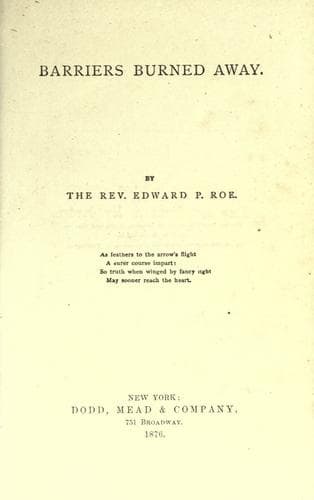
Chicago (Ill.) -- History -- To 1875 -- Fiction; Fires -- Fiction; Great Fire, Chicago, Ill., 1871 -- Fiction; Historical fiction
In the gray dawn Ethel Fleet, summoned from her rest, received her
son, weak, unconscious, muttering in delirium, and not recognizing
even her familiar face. He was indeed a sad, painful contrast to the
ruddy, buoyant youth who had left her a few short months before,
abounding in hope and life. But she comforted herself with the thought
that neither sin nor shame had brought him home.
We need not dwell on the weary weeks that followed. Dennis had every
advantage that could result from good medical skill and the most
faithful nursing. But we believe that his life lay rather in his
mother's prayers of faith. In her strong realization of the spiritual
world she would go continually into the very presence of Jesus, and
say, "Lord, he whom Thou lovest is sick"; or, like parents of old, she
would seem by her importunity to bring the Divine Physician to his
very bedside.
Mr. Bruder, too, insisted on remaining, and watched with the unwearied
faithfulness of one who felt that he owed to Dennis far more than life.
It was indeed touching to see this man, once so desperate and depraved,
now almost as patient and gentle as the mother herself, sitting by his
unconscious friend, often turning his eyes heavenward and muttering
in deep guttural German as sincere a prayer as ever passed human lips,
that Dennis might be spared.
The hand of God seemed about to take him from them, but their strong,
loving faith laid hold of that hand, and put upon it the restraint
that only reverent, believing prayer can. Dennis lived. After many
days delirium ceased, and the confused mind became clear. But during
his delirium Ethel and Mr. Bruder learned from the oft-repeated words,
"Cruel, cruel Christine!" the nature of the wound that had nearly
destroyed his life.
Mr. Ludolph was late in reaching his home on the evening after Dennis
was taken sick. Christine sat in the dusk on the ivy-shaded piazza,
awaiting him. He said, abruptly, "What have you been doing to Fleet,
over here?"
For a second her heart stood still, and she was glad the increasing
gloom disguised her face. By a great effort she replied, in a cool,
matter-of-fact tone: "I do not understand your question. Mr. Fleet was
here this afternoon, and gave some finishing touches to my studio. I
do not think I shall need him any more."
Her quiet, indifferent voice would have disarmed suspicion itself.
"It is well you do not, for he seems to have received some 'finishing
touches' himself. He fell across the threshold of the store in a dead
faint, and has gone home, threatened with a serious illness."
Even her resolute will could not prevent a sharp, startled exclamation.
"What is the matter?" said her father, hastily; "you are not going to
faint also, are you?"
"No," said Christine, quietly again; "but I am tired and nervous, and
you told your news so abruptly! Why, it seemed but a moment ago he was
here at work, and now he is dangerously ill. What an uncertain stumbling
forward in the dark life is!"
Public-domain text, read in full here on John Shaqi.
Reviews
Reviews
No reviews yet
Be the first to share your thoughts on this work.
Elsewhere in the archive
Join the Discussion
Join the discussion
Sign in to leave a comment or review.
Sign InorCreate an account