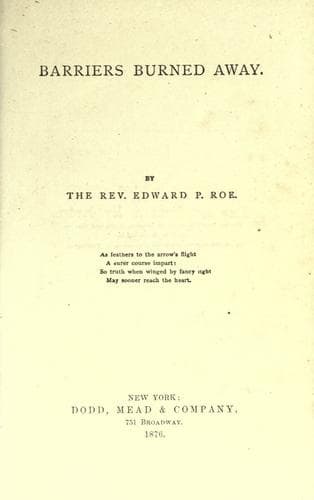
Chicago (Ill.) -- History -- To 1875 -- Fiction; Fires -- Fiction; Great Fire, Chicago, Ill., 1871 -- Fiction; Historical fiction
But as she went over the past (and this now she often did), she saw
that he was unusually gifted; nay, more, the picture she discovered
in the loft of the store proved him possessed of genius of a high
order. And such a man she had deceived, tortured, and even killed!
This was the verdict of her own conscience, the assertion of his own
lips. She remembered the wearing life of alternate hope and fear she
had caused him. She remembered how eagerly he hung on her smiles and
sugared nothings, and how her equally causeless frowns would darken
all the world to him. She saw day after day how she had developed in
a strong, true heart, with its native power to love unimpaired, the
most intense passion, and all that her own lesser light might burn a
little more brightly. Then, with her burning face buried in her hands,
she would recall the bitter, shameful consummation. Worse than all,
waking or sleeping, she continually saw a pale, thin face, that even
in death looked upon her with unutterable reproach. In addition to the
misery caused by her remorse, there was a deeper bitterness still.
Within the depths of her soul a voice told her that the picture was
true; that he might have awakened her, and led her out into the warmth
and light of a happy life--a life which she felt ought to be possible,
but which as yet had been but a vague and tantalizing dream. Now the
world seemed to her utter chaos--a place of innumerable paths leading
nowhere; and her own hands had broken the clew that might have brought
her to something assured and satisfactory. She was very wretched, for
her life seemed but a little point between disappointment on one side
and the blackness of death and nothingness on the other. The very
beauty of the landscapes about her often increased her pain. She felt
that a few weeks ago she would have enjoyed them keenly, and found in
their transference to canvas a source of unfailing pleasure. With a
conscious blush she thought that if he were present to encourage, to
stimulate her, by the very vitality of his earnest, loving nature, she
would be in the enjoyment of paradise itself. In a word, she saw the
heaven she could not enter.
To the degree that she had mind, heart, conscience, and an intense
desire for true happiness, she was unhappy. Dress, dancing, the passing
admiration of society, the pleasures of a merely fashionable life,
seemed less and less satisfactory. She was beyond them, as children
outgrow their toys, because she had a native superiority to them, and
yet they seemed her best resource. She had all her old longing to
pursue her art studies, and everything about her stimulated her to
this, but her heart and hand appeared paralyzed. She was in just that
condition, mental and moral, in which she could do nothing well.
Public-domain text, read in full here on John Shaqi.
Reviews
Reviews
No reviews yet
Be the first to share your thoughts on this work.
Elsewhere in the archive
Join the Discussion
Join the discussion
Sign in to leave a comment or review.
Sign InorCreate an account