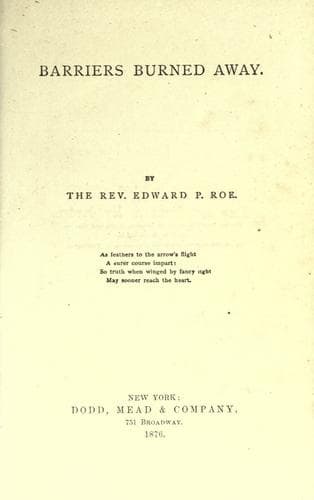
Chicago (Ill.) -- History -- To 1875 -- Fiction; Fires -- Fiction; Great Fire, Chicago, Ill., 1871 -- Fiction; Historical fiction
"I am not so sure about that. I know many eminent saints in the church
who will eat lobster salad for supper, and then send for the doctor
and minister before morning. There is a precious twaddle about
'mysterious Providence.' Providence isn't half so mysterious as people
make out. The doctor is expected to look serious and sympathetic, and
call their law-breaking and its penalty by some outlandish Latin name
that no one can understand. I give 'em the square truth, and tell 'em
they've been breaking the commandments."
Dennis could not forbear smiling at the doctor's rough handling of
humbug, even in one of its most respectable guises. Then, remembering
his mother, he added, gravely: "I am truly anxious about my mother,
she has grown so feeble. I want, and yet dread, the truth."
The bantering manner of the good old doctor changed at once, and he
said, kindly, "I'll come, my boy, within a few days, though I am nearly
run off my feet."
He went off, muttering, "Why don't the people send for some of the
youngsters that sit kicking up their heels in their offices all day?"
Dennis soon fell into the routine of work and rapidly grew stronger.
But his face had acquired a gravity, a something in expression that
only experience gives, which made him appear older by ten years. All
trace of the boy had gone, and his countenance was now that of the
man, and of one who had suffered.
As soon as he recovered sufficient strength to act with decision, he
indignantly tried to banish Christine's image from his memory. But he
found this impossible. Though at times his eyes would flash, in view
of her treatment, they would soon grow gentle and tender, and he found
himself excusing and extenuating, by the most special pleadings, that
which he had justly condemned.
One evening his mother startled him out of a long revery, in which he
had almost vindicated Christine, by saying, "A very pleasant smile has
been gradually dawning on your face, my son."
"Mother," replied he, hesitatingly, "perhaps I have judged Miss Ludolph
harshly."
"Your love, not your reason, has evidently been pleading for her."
"Well, mother, I suppose you are right."
"So I suppose the Divine love pleads for the weak and sinful," said
Mrs. Fleet, dreamily.
"That is a very pleasant thought, mother, for sometimes it seems that
my love could make black white."
"That the Divine love has done, but at infinite cost to itself."
"Oh that my love at any cost to itself could lead her into the new
life of the believer!" said Dennis, in a low, earnest tone.
Public-domain text, read in full here on John Shaqi.
Reviews
Reviews
No reviews yet
Be the first to share your thoughts on this work.
Elsewhere in the archive
Join the Discussion
Join the discussion
Sign in to leave a comment or review.
Sign InorCreate an account