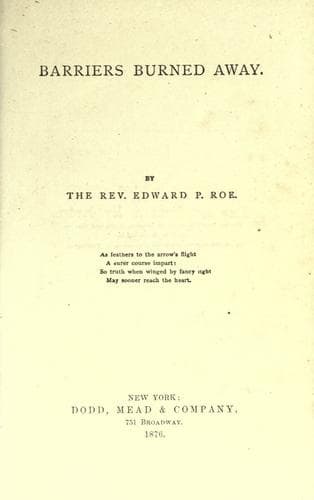
Chicago (Ill.) -- History -- To 1875 -- Fiction; Fires -- Fiction; Great Fire, Chicago, Ill., 1871 -- Fiction; Historical fiction
Hastily throwing aside her wrappings, she began to walk up and down
in her excitement. Her listlessness was gone now in very truth, and
her eye and cheek glowed as never before. As if it had become the great
vivifying principle of her own life, she kept repeating continually
in a low, ecstatic tone, "He lives! he lives! he is not dead; his blood
is not upon my conscience!"
At last she sat down in her luxurious chair before the window to think
it all over--to commune with herself--often the habit of the reserved
and solitary. From the disjointed sentences she let fall, from the
reflection of her excited face in yonder glass, we gather quite
correctly the workings of her mind. Her first words were, "Thank heaven!
thank something or other, I have not blotted out that true, strong
genius."
Again--"What untold wretchedness I might have saved myself if I had
only asked the question, in a casual way, 'How is Mr. Fleet?' Christine
Ludolph, with all your pride and imagined superiority, you can be very
foolish.
"How he hates and despises me now! little wonder!"
"But if he knew!"
"Knew what? Why could you not ask after him, as after any other sick
man? You have had a score or so of offers, and did not trouble yourself
as to the fate of the lovelorn swains. Seems to me your conscience has
been very tender in this case. And the fact that he misjudges you,
thinks you callous, heartless, and is angry, troubles you beyond
measure."
"When before were you so sensitive to the opinion of clerks and
trades-people, or even the proudest suitors for your hand? But in this
case you must cry out, in a tone of sentimental agony, 'Oh, if he only
knew it!"
"Knew what?"
Her face in yonder mirror has a strange, introverted expression, as
if she were scanning her own soul. Her brow contracts with thought and
perplexity.
Gradually a warm, beautiful light steals into her face, transforming
it as from the scowl of a winter morning into a dawn of June; her eyes
become gentle and tender. A rich color comes out upon her cheeks,
spreads up her temples, mantles her brow, and pours a crimson torrent
down her snowy neck. Suddenly she drops her burning face into her
hands, and hides a vision one would gladly look longer upon. But see,
even her little ears have become as red as coral.
The bleakest landscape in the world brightens into something like
beauty when the sun shines upon it. So love, the richer, sweeter light
of the soul, make the plainest face almost beautiful; but when it
changed Christine Ludolph's faultless, yet too cold and classical,
features into those of a loving woman's, it suggested a beauty scarcely
human.
A moment later there came a faint whisper: "I fear--I almost fear I
love him." Then she lifted a startled, frightened face and looked
timidly around as if, in truth, walls had ears.
Public-domain text, read in full here on John Shaqi.
Reviews
Reviews
No reviews yet
Be the first to share your thoughts on this work.
Elsewhere in the archive
Join the Discussion
Join the discussion
Sign in to leave a comment or review.
Sign InorCreate an account