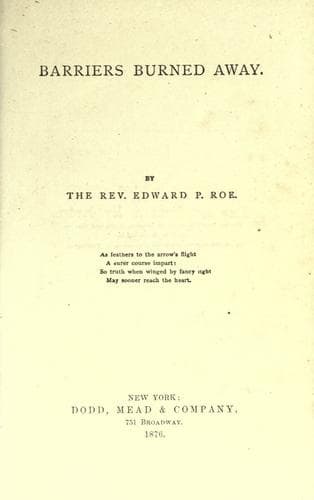
Chicago (Ill.) -- History -- To 1875 -- Fiction; Fires -- Fiction; Great Fire, Chicago, Ill., 1871 -- Fiction; Historical fiction
"A truce to your bantering, father! Mr. Fleet is humble only in station,
not in character, not in ability. You know I have never been very
tender with the 'victims,' as you designate them, of the Mellen stamp;
but Mr. Fleet is a man, in the best sense of the word, and one that
I have wronged. Now that the folly is past I may as well explain to
you some things that have appeared strange. I think I can truly say
that I have given those gentlemen who have honored, or rather annoyed
me, by their unwished-for regard, very little encouragement. Therefore,
I was not responsible for any follies they might commit. But for
artistic reasons I did encourage Mr. Fleet's infatuation. You remember
how I failed in making a copy of that picture. In my determination to
succeed, I hit upon the rather novel expedient of inspiring and copying
the genuine thing. You know my imitative power is better than my
imagination, and I thought that by often witnessing the expression of
feeling and passion, I might learn to portray it without the
disagreeable necessity of passing through any such experiences myself.
But the experiment, as you know, did not work well. These living
subjects are hard to manage, and, as I have said, I am troubled by a
conscience."
Mr. Ludolph's eyes sparkled, and a look of genuine admiration lighted
up his features.
"Brava!" he cried; "your plan was worthy of you and of your ancestry.
It was a real stroke of genius. You were too tender-hearted, otherwise
it would have been perfect. What are the lives of a dozen such young
fellows compared with the development and perfection of such a woman
as you bid fair to be?"
Christine had displayed in this transaction just the qualities that
her father most admired. But even she was shocked at his callousness,
and lifted a somewhat startled face to his.
"Your estimate of human life is rather low," she said.
"Not at all. Is not one perfect plant better than a dozen imperfect
ones? The gardener often pulls up the crowding and inferior ones to
throw them about the roots of the strongest, that in their death and
decay they may nourish it to the highest development. The application
of this principle is evident. They secure most in this world who have
the skill and power to grasp most."
"But how about the rights of others? Conscious men and women are not
plants."
"Let them be on their guard then. Every one is for himself in this
world. That can be plainly seen through the thin disguises that some
try to assume. After all, half the people we meet are little better
than summer weeds."
Public-domain text, read in full here on John Shaqi.
Reviews
Reviews
No reviews yet
Be the first to share your thoughts on this work.
Elsewhere in the archive
Join the Discussion
Join the discussion
Sign in to leave a comment or review.
Sign InorCreate an account