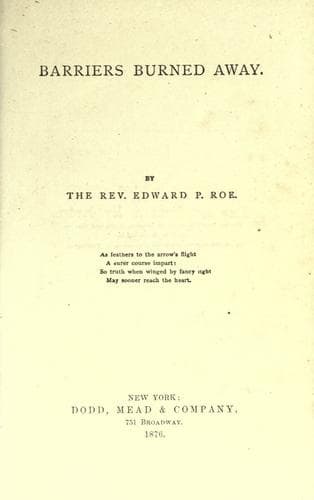
Chicago (Ill.) -- History -- To 1875 -- Fiction; Fires -- Fiction; Great Fire, Chicago, Ill., 1871 -- Fiction; Historical fiction
"I never was so proud of Chicago," she exclaimed. "It is the greatest
city in the world. Only the other day her streets were prairies. I
believe my husband expected to find buffalo and Indians just outside
the town. But see! already, by its liberality and attention to art,
it begins to vie with some of our oldest cities. But what is the matter?
You look so worried."
"Oh, nothing," said Dennis, coming out of his troubled, abstracted
manner.
With her quick intuition, Mrs. Leonard at once divined his thoughts,
and said soon after, when her husband's back was turned: "All I can
say is, that she was deeply, most deeply affected by your picture, but
she said nothing to me, more than to express her admiration. My friend,
you had better forget her. They sail for Europe very soon; and, besides,
she is not worthy of you."
"I only wish I could forget her, and am angry with myself but I cannot,"
he replied, and soon after said "good-night."
Wandering aimlessly through the streets, he almost unconsciously made
his way to the north side, where the Ludolph mansion was situated. Then
a strong impulse to Go to it came over him, and for the first time
since the far-off day when, stunned and wounded by his bitter
disappointment, he had gone away apparently to die, he found himself
at the familiar place. The gas was burning in Mr. Ludolph's library.
He went around on the side street (for the house was on a corner), and
a light shone from what he knew to be Christine's studio. She
undoubtedly was there. Even such proximity excited him strangely, and
in his morbid state he felt that he could almost kiss the feeble rays
that shimmered out into the darkened street. In his secret soul he
utterly condemned his folly, but promised himself that he would be
weak no longer after that one night. The excitements of the day had
thrown him off his balance.
Suddenly he heard, sweet and clear, though softened by distance and
intervening obstacles, the same weird, pathetic ballad that had so
moved him when Christine sang it at Le Grand Hotel, on the evening
after he had pointed out the fatal defect in her picture. At short
intervals, kindred and plaintive songs followed.
"There is nothing exultant or hopeful about those strains," he said
to himself. "For some reason she is not happy. Oh, that I might have
one frank conversation with her and find out the whole truth! But it
seems that I might just as well ask for a near look at yonder star
that glimmers so distantly. For some reason I cannot believe her so
utterly heartless as she has seemed; and then mother has prayed. Can
it all end as a miserable dream?"
Late at night the music ceased, and the room was darkened.
Little dreamed Christine that her plaintive minstrelsy had fallen on
so sympathetic an ear, and that the man who seemingly had repelled her
slightest acquaintance had shivered long hours in the cold, dark street.
Public-domain text, read in full here on John Shaqi.
Reviews
Reviews
No reviews yet
Be the first to share your thoughts on this work.
Elsewhere in the archive
Join the Discussion
Join the discussion
Sign in to leave a comment or review.
Sign InorCreate an account