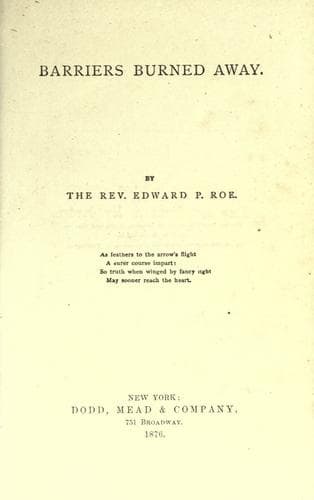
Chicago (Ill.) -- History -- To 1875 -- Fiction; Fires -- Fiction; Great Fire, Chicago, Ill., 1871 -- Fiction; Historical fiction
At last she raised her head, turned, and gave one long parting look,
and, as Dennis saw her face in the white moonlight, it was the face
of a pitying angel. A low "Farewell!" trembled from her lips, she
leaned heavily on his arm, they turned away, and seemingly the curtain
fell between father and child to rise no more.
"Mr. Fleet," she said, pleadingly, "are you too tired to take me to
my old home on the north side?"
"Miss Ludolph, I could go to the ends of the earth for you, but you
are not equal to this strain upon your feelings. Have mercy on
yourself."
But she said, in a low, dreamy tone: "I wish to take leave to-night
of my old life--the strange, sad past with its mystery of evil; and
then I shall set my face resolutely toward a better life--a better
country. So bear with me, my true, kind friend, a little longer."
"Believe me, my thought was all for you. All sense of fatigue has
passed away."
Silently they made their way, till they stood where, a few short days
before, had been the elegant home that was full of sad and painful
memories to both.
"There was my studio," she said in the same dreamy tone, "where I
indulged in my wild, ambitious dreams, and sought to grasp a little
fading circlet of laurel, while ignoring a heavenly and an immortal
crown. There," she continued, her pale face becoming crimson, even in
the white moonlight, "I most painfully wronged you, my most generous,
forgiving friend, and a noble revenge you took when you saved my life
and led me to a Saviour. May God reward you; but I humbly ask your
pardon--"
"Please, Miss Ludolph, do not speak of that. I have buried it all. Do
not pain yourself by recalling that which I have forgiven and almost
forgotten. You are now my ideal of all that is noble and good, and in
my solitary artist life of the future you shall be my gentle yet potent
inspiration."
"Why must your life be solitary in the future?" she asked, in a low
tone.
He was very pale, and his arm trembled under her hand; at last he said,
in a hoarse voice, "Do not ask me. Why should I pain you by telling
you the truth?"
"Is it the part of a true friend to refuse confidence?" she asked,
reproachfully.
He turned his face away, that she might not see the evidences of the
bitter struggle within--the severest he had ever known; but at last
he spoke in the firm and quiet voice of victory. She had called him
brother, and trusted him as such. She had ventured out alone on a
sacred mission with him, as she might with a brother. She was dependent
on him, and burdened by a feeling of obligation. His high sense of
honor forbade that he should urge his suit under such circumstances.
If she could not accept, how painful beyond words would be the necessity
of refusal, and the impression had become almost fixed in his mind
that her regard for him was only sisterly and grateful in its character.
Public-domain text, read in full here on John Shaqi.
Reviews
Reviews
No reviews yet
Be the first to share your thoughts on this work.
Elsewhere in the archive
Join the Discussion
Join the discussion
Sign in to leave a comment or review.
Sign InorCreate an account