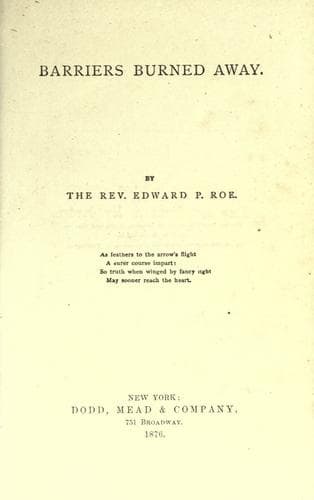
Chicago (Ill.) -- History -- To 1875 -- Fiction; Fires -- Fiction; Great Fire, Chicago, Ill., 1871 -- Fiction; Historical fiction
She treated the young men whom she met in society with a courtly ease
and freedom, but her smiles and repartee ever seemed like brilliant
moonlight that had no warmth; and, while no restraint appeared, she
still kept all at a distance. There was a marked difference in her
intercourse with Dennis. Regarding him as too humble ever to presume
upon her frankness, she daily spoke more freely, and more truly acted
out herself before him. She was happy and in her element among the
beautiful works of art they were arranging, and in this atmosphere her
womanly nature, chilled and dwarfed though it was, would often manifest
itself in ways sweet and unexpected. Under no other circumstances could
she have appeared so well. She as often spoke to herself in racy comment
on what was before her as to Dennis, and ever and anon would make some
pleasant remark to him, as she might throw a dainty morsel to her
greyhound Wolf, looking wistfully at her while she dined. At the same
time it must be confessed that she had a growing respect for him, as
she daily saw some new proof of his intelligence and taste; but both
education and disposition inclined her instinctively to the old feudal
idea that even genius, if poor, must wait a humble servitor on wealth
and rank, and where a New England girl would have been saying to
herself, "This gifted, educated man is my equal, and, whether I want
to or not, I ought to treat him as such," she was not troubled at all.
To her, he was her father's clerk and man-of-all-work, a most useful,
trusted, and agreeable servant, and she was kind to him as such. Indeed
the little autocrat was kind to every one that pleased her. She was
a benign queen to obedient subjects, but woe to those who were
otherwise.
To Dennis, however, though he realized it not, she was becoming as the
very apple of his eye. He was learning to regard her with a deeper
interest because of the very defects that he plainly recognized. While
on the one hand he had the enthusiastic love caused by his admiration
for her, on the other he felt the tenderer and greater love which was
the result of pity. He tried to account for his feelings toward her
by the usual sophistries of unconscious lovers. It was friendship; it
was artistic interest in her beauty; it was the absorbing, unselfish
regard of a Christian for one providentially commended to him to be
led out of darkness into light. How could he help thinking of one for
whom he prayed night and morning and every hour in the day? It was all
this, but he was soon to learn that it was a great deal more. And so
the days of occupation and companionship passed; the spell worked on
with increasing and bewildering power, and the crisis could not be
delayed much longer.
Public-domain text, read in full here on John Shaqi.
Reviews
Reviews
No reviews yet
Be the first to share your thoughts on this work.
Elsewhere in the archive
Join the Discussion
Join the discussion
Sign in to leave a comment or review.
Sign InorCreate an account