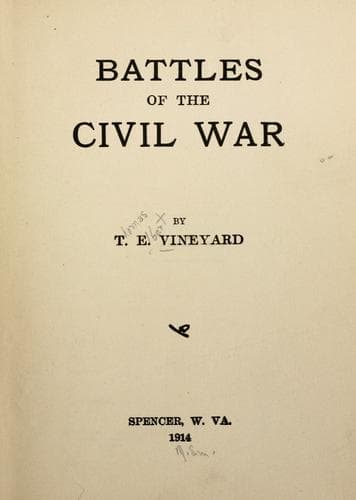
United States -- History -- Civil War, 1861-1865 -- Campaigns
During the early months of 1864 the authorities at Washington became
discouraged with General Meade's management of the Army of the Potomac.
They thought that he should have destroyed Lee's army on its retreat
from Gettysburg; while it is now conceded that Meade's management
was good, and that he did all that any general could have done under
the circumstances. General Grant had come into great favor in the
North on account of his successive victories in the West, and it was
decided to give Grant command of all the Federal forces, with the rank
of lieutenant-general. This high grade in command had been held only
by Generals Washington and Scott, thus bringing together two great
generals. One the idol of the North: the other of the South. Cæsar said
he would rather be first man in a village in Gaul than second in Rome.
Grant found under his command in the Army of the Potomac 140,000 men.
Lee found under his command scarcely 60,000 men, but that spirit
burned in the breast of his soldiers notwithstanding their defeat at
Gettysburg and their loss of Vicksburg, that many hard battles would be
fought before the heel of the invader should tread upon the streets of
their cherished capital, Richmond.
Grant determined to move upon Richmond and by doing so began with the
Wilderness a series of battles which are unequaled in history.
Grant's army was divided into three corps, commanded by Hancock, Warren
and Sedgwick. Sheridan was in command of the cavalry. Burnside was in
command of another division of the army, protecting the Orange and
Alexandria railroad.
Lee's army consisted of three corps of infantry, commanded by
Longstreet, Ewell and A. P. Hill, and the cavalry by Stuart. A notable
fact in the organization of the Confederate army was the few changes
made in commanders.
Early on the morning of May 4th Grant's army began crossing the Rapidan
below Lee's entrenchments. This being anticipated by Lee, he at once
prepared to set his own army in motion and throw himself across the
path of his foe. Both armies were now near Chancellorsville, in a
wilderness country, where a great battle had been fought the year
before. This country was covered by underbrush and ragged foliage,
with scrub pine, and dotted here and there with small clearings. This
wilderness country was pierced by a few roads leading from the fords
of the river. The Federals had advanced up these roads as far as the
Wilderness Tavern, in which General Grant established his headquarters.
This wilderness country was entered by two roads from the southwest
known as the "Old Orange Turnpike" and the "Orange Plank Road." Along
these two roads the Confederates moved their army to meet the advancing
hosts of the Federals, General Ewell leading his corps along the
turnpike and A. P. Hill along the plank road. General Longstreet was
hastening up from Gordonsville, and it was very evident that a great
battle was near at hand.
Public-domain text, read in full here on John Shaqi.
Reviews
Reviews
No reviews yet
Be the first to share your thoughts on this work.
Elsewhere in the archive
Join the Discussion
Join the discussion
Sign in to leave a comment or review.
Sign InorCreate an account