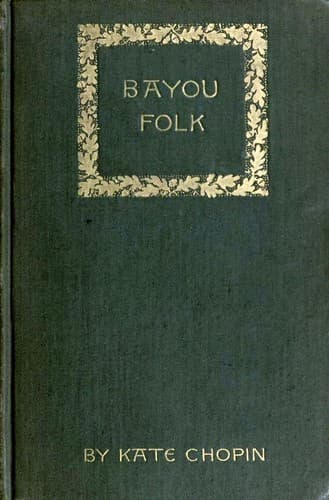
Louisiana -- Social life and customs -- Fiction; Short stories, American
Azenor had already in his eagerness arranged a tray, upon which
was a smoking cup of _café au lait_. He had buttered and jellied
generous slices of bread, and was searching wildly for something when
Tranquiline reëntered.
"W'at become o' that half of chicken-pie, Tranquiline, that was yere in
the _garde manger_ yesterday?"
"W'at chicken-pie? W'at _garde manger_?" blustered the woman.
"Like we got mo' 'en one _garde manger_ in the house, Tranquiline!"
"You jis' like ole Ma'ame Azenor use' to be, you is! You 'spec'
chicken-pie gwine las' etarnal? W'en some'pin done sp'ilt, I flings it'
way. Dat's me--dat's Tranquiline!"
So Azenor resigned himself,--what else could he do?--and sent the tray,
incomplete, as he fancied it, out to Lalie.
He trembled at thought of what he did; he, whose nerves were usually as
steady as some piece of steel mechanism.
Would it anger her if she suspected? Would it please her if she knew?
Would she say this or that to Tranquiline? And would Tranquiline tell
him truly what she said--how she looked?
As it was Sunday, Azenor did not work that afternoon. Instead, he
took a book out under the trees, as he often did, and sat reading it,
from the first sound of the Vesper bell, that came faintly across the
fields, till the Angelus. All that time! He turned many a page, yet in
the end did not know what he had read. With his pencil he had traced
"Lalie" upon every margin, and was saying it softly to himself.
* * * * *
Another Sunday Azenor saw Lalie at mass--and again. Once he walked with
her and showed her the short cut across the cotton-field. She was very
glad that day, and told him she was going to work--her grandmother said
she might. She was going to hoe, up in the fields with Monsieur Le
Blôt's hands. He entreated her not to; and when she asked his reason,
he could not tell her, but turned and tore shyly and savagely at the
elder-blossoms that grew along the fence.
Then they stopped where she was going to cross the fence from the field
into the lane. He wanted to tell her that was his house which they
could see not far away; but he did not dare to, since he had fed her
there on the morning she was hungry.
"An' you say yo' gran'ma's goin' to let you work? She keeps you f'om
workin', _donc_?" He wanted to question her about her grandmother, and
could think of no other way to begin.
"Po' ole grand'mère!" she answered. "I don' b'lieve she know mos' time
w'at she's doin'. Sometime she say' I aint no betta an' one nigga, an'
she fo'ce me to work. Then she say she know I'm goin' be one canaille
like maman, an' she make me set down still, like she would want to kill
me if I would move. Her, she on'y want' to be out in the wood', day an'
night, day an' night. She ain' got her right head, po' grand'mère. I
know she ain't."
Public-domain text, read in full here on John Shaqi.
Reviews
Reviews
No reviews yet
Be the first to share your thoughts on this work.
Elsewhere in the archive
Join the Discussion
Join the discussion
Sign in to leave a comment or review.
Sign InorCreate an account