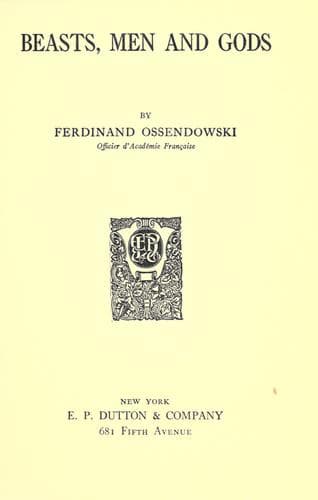
Communism -- Soviet Union; Mongolia -- Description and travel
The interior of the building was arranged with splendor. On the ground
floor was the dining-room, furnished with richly carved, heavy blackwood
Chinese tables and cabinets filled with porcelains and bronze. Above
were two rooms, the first a bed-room hung with heavy yellow silk
curtains; a large Chinese lantern richly set with colored stones hung
by a thin bronze chain from the carved wooden ceiling beam. Here stood
a large square bed covered with silken pillows, mattresses and blankets.
The frame work of the bed was also of the Chinese blackwood and carried,
especially on the posts that held the roof-like canopy, finely executed
carvings with the chief motive the conventional dragon devouring the
sun. By the side stood a chest of drawers completely covered with
carvings setting forth religious pictures. Four comfortable easy chairs
completed the furniture, save for the low oriental throne which stood on
a dais at the end of the room.
“Do you see this throne?” said the Hutuktu to me. “One night in winter
several horsemen rode into the monastery and demanded that all the
Gelongs and Getuls with the Hutuktu and Kanpo at their head should
congregate in this room. Then one of the strangers mounted the throne,
where he took off his bashlyk or cap-like head covering. All of the
Lamas fell to their knees as they recognized the man who had been long
ago described in the sacred bulls of Dalai Lama, Tashi Lama and Bogdo
Khan. He was the man to whom the whole world belongs and who has
penetrated into all the mysteries of Nature. He pronounced a short
Tibetan prayer, blessed all his hearers and afterwards made predictions
for the coming half century. This was thirty years ago and in the
interim all his prophecies are being fulfilled. During his prayers
before that small shrine in the next room this door opened of its own
accord, the candles and lights before the altar lighted themselves and
the sacred braziers without coals gave forth great streams of incense
that filled the room. And then, without warning, the King of the World
and his companions disappeared from among us. Behind him remained no
trace save the folds in the silken throne coverings which smoothed
themselves out and left the throne as though no one had sat upon it.”
The Hutuktu entered the shrine, kneeled down, covering his eyes with his
hands, and began to pray. I looked at the calm, indifferent face of the
golden Buddha, over which the flickering lamps threw changing shadows,
and then turned my eyes to the side of the throne. It was wonderful and
difficult to believe but I really saw there the strong, muscular figure
of a man with a swarthy face of stern and fixed expression about the
mouth and jaws, thrown into high relief by the brightness of the eyes.
Through his transparent body draped in white raiment I saw the Tibetan
inscriptions on the back of the throne. I closed my eyes and opened
them again. No one was there but the silk throne covering seemed to be
moving.
Public-domain text, read in full here on John Shaqi.
Reviews
Reviews
No reviews yet
Be the first to share your thoughts on this work.
Elsewhere in the archive
Join the Discussion
Join the discussion
Sign in to leave a comment or review.
Sign InorCreate an account