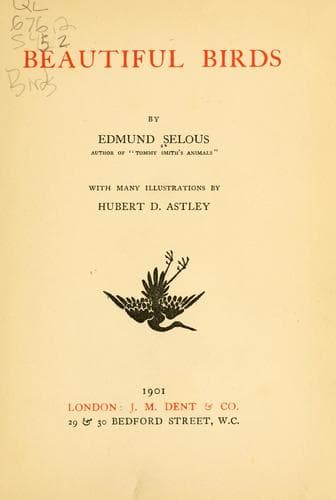
Birds -- Juvenile literature; Birds of paradise (Birds) -- Juvenile literature
The Little Flame-bearer (there is a name for you!) is a still smaller
Humming-bird than the last one--indeed his body, without the feathers,
would not be _very_ much larger than a _very_ large humble-bee. Here,
again, all the wonder is on its throat, which is topaz and green and
copper, all glowing and sparkling together, as if they were all married
to one another and each of them was trying to get the upper hand. Ah,
was there ever such a sweet little gem-bird? He is a jewel mounted
on wings and set in the air. Only sometimes, when he hovers just
underneath a flower, he seems hanging from its tip like a pendant.
Costa's Coquette (that means that some one named Costa--some Portuguese
gentleman--was the first to write about it) is larger than the Little
Flame-bearer (though not half so big as a wren), and he _tries_ to
be brighter. Whether he _is_ brighter I am sure I can't say. To tell
properly, one ought to see them both hovering under the same flower,
or, at least, very close together, and even then one would only feel
bewildered. But this one's head and throat are all one splendour, one
marvellous gleam of rosy, pinky, rosy-pink, pinky-rose magenta. Only
if you _say_ that that is what it is, it will change into violet and
contradict you, and then, if you say it is violet, it will change into
topaz and contradict you again. So you had better say nothing--for one
does not want to be contradicted--but just hold your breath and watch
it. It will change quite soon enough, even then, long before you are
tired of its rosy, pinky, rosy-pink, pinky-rose magenta, which is a
colour you have not seen, and which I have not told you about before.
Only if you _must_ say something about it whilst you are looking at
it--something besides "Oh!" I mean--say it is a Humming-bird. That
will be quite sufficient, and not one of its colours can be offended
with you then for not mentioning them and mentioning the others. Now,
I must tell you that the feathers of this little bird's throat--of
that wonderful, gleaming throat-gorget--grow out on each side into two
little peaks, two little pointed tongues of rose-pink magenta flame
(but hush!), and he can spread them out and shoot them forward, as well
as the whole of the gorget, in quite a wonderful way. When he does
that, what he _seems_ to do is to strike a great number of matches at
the same time, and from each one, as he strikes it, there bursts out
hundreds and hundreds of bright, sparkling jewels of flame. Ah, you
should see him strike his jewel-matches--all together, all the jewels
that there are, all struck in one second, as he whizzes about in the
air. His back is all green, and _so_ bright, if only you cover up his
head and throat. If you don't cover them--or as soon as you uncover
them again--you hardly seem to see it. It is no brighter then than a
glow-worm is when a very bright star is shooting through the air.
Public-domain text, read in full here on John Shaqi.
Reviews
Reviews
No reviews yet
Be the first to share your thoughts on this work.
Elsewhere in the archive
Join the Discussion
Join the discussion
Sign in to leave a comment or review.
Sign InorCreate an account