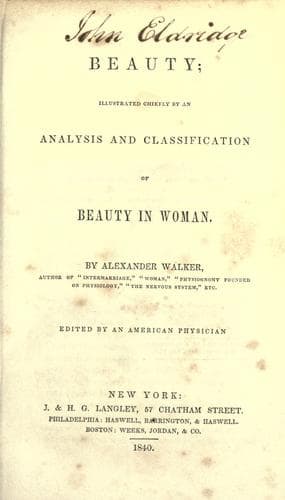
Beauty: Illustrated Chiefly by an Analysis and Classification of Beauty in WomanWalker, Alexander
Philosophy
Beauty: Illustrated Chiefly by an Analysis and Classification of Beauty in Woman
Walker, Alexander
Beauty, Personal; Women
If, say they, among the forms and the features which we compare, some are
associated by us with certain qualities or sentiments which please us,
they equally lead us to a predilection or prejudice, in consequence of
which the most common or the least beautiful figure is preferred to the
most perfect. In this case, the imagination has perverted the judgment.
Winckelmann truly observes, that young people are most exposed to such
errors: placed under the influence of sentiment and of illusion, they
often regard, as very beautiful, women who have nothing capable of
charming, but an animated physiognomy, in which breathe desire,
voluptuousness, and languor. The results of this as to life may easily be
foreseen.
Of the excess to which such prejudice may go, a good instance is adduced
in Descartes, who preferred women who squinted to the most perfect
beauties, because squinting was one of the most remarkable features of
the woman who was the first object of his affections.
Winckelmann observes that even artists themselves have not always an
exquisite sentiment of beauty: their first impressions have often an
influence which they cannot overcome, nor even weaken, especially when, at
a distance from the admirable productions of the ancients, they cannot
rectify their first judgments.
Circumstances of profession, it is truly observed, may also lead to
associations of ideas capable of deceiving us in our opinions respecting
beauty. Men are apt to refer everything to their exclusive knowledge and
the mode of judging which it employs. The "what does that prove" of the
mathematician, when judging the finest products of imagination, has passed
into a proverb. And every one knows of that other cultivator of the same
science, who declared that he never could discover anything sublime in
Milton's Paradise Lost, but that he could never read the queries at the
end of one of the books in Newton's Optics, without his hair standing on
end and his blood running cold.
The necessity of the third condition, namely, advanced civilization, to a
right judgment respecting a standard of beauty in woman, is evident, when
we consider that it requires a taste formed by the habit of bringing
things together and of comparing them.
One accustomed to see, says Hume, "and examine, and weigh the several
performances, admired in different ages and nations, can alone rate the
merits of a work exhibited to his view, and assign its proper rank among
the productions of genius."
Public-domain text, read in full here on John Shaqi.
Reviews
Reviews
No reviews yet
Be the first to share your thoughts on this work.
Elsewhere in the archive
Join the Discussion
Join the discussion
Sign in to leave a comment or review.
Sign InorCreate an account