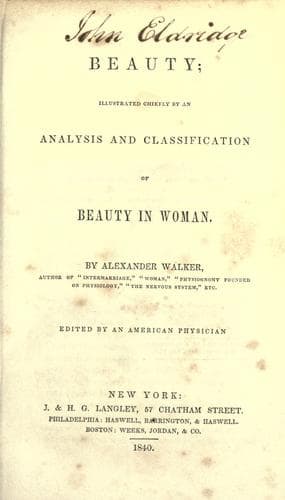
Beauty: Illustrated Chiefly by an Analysis and Classification of Beauty in WomanWalker, Alexander
Philosophy
Beauty: Illustrated Chiefly by an Analysis and Classification of Beauty in Woman
Walker, Alexander
Beauty, Personal; Women
It has been suggested, that the Greek or Ionian women, whose arms were of
so perfect a form, owed that beauty in some measure to the custom of
leaving them nude, or covered only by loose drapery: as in that case, no
pressure constricted the roundness of the fleshy parts, and prevented
their development; no ligature, binding the upper part of the arm, altered
the color of the skin; and the arm, being always uncovered, received at
the toilet the same attention as other parts. Hence, it is supposed
antique statuary has left us such admirable models of the beauty of this
part.
It is certainly not improbable that we may attribute the absence of this
beauty, in some measure, to a custom which, in many cases, medicine may
approve, but which is unfavorable to the arm, that of wearing long
sleeves; but want of exercise is its great cause.
The form of the hand often announces the occupation of the person to whom
it belongs, and sometimes even her particular capabilities. There
certainly are hands that we may call intellectual; and there are others
that we may call foolish or stupid. Of the hand, Lavater says, that,
whether in movement or in repose, its expression cannot be mistaken: its
most tranquil position indicates our natural dispositions; its flexions,
our actions and our passions.
The ancients, it has been observed, attached much importance to the form
of the feet: the philosophers did not neglect it in the general view of
the physiognomy; and the historians as well as the poets made mention of
their beauty, in speaking of Polyxene, Aspasia, and others; as they did of
their deformities in speaking of the emperor Domitian.
Perfection or deformity of the feet is no doubt in general hereditary; but
good management will preserve the former of these, and repair the latter.
We commonly deform these parts by means of our shoes: the second toe,
observes a writer on this subject, which naturally projects most, as we
see from the antique, is arrested in its development, and the foot, which
ought, in the outline of its extremity, to approach to the elegant form of
the ellipsis, is rounded without beauty, and is disfigured by our
ridiculous compressions.[33]
_Second Variety or Modification of this Species of Beauty._
The joints generally are small in woman, and especially so in the
extremities. The elbow joint is softly rounded; and the various joints of
the fingers are marked chiefly by little reliefs and faint shadows. The
articulation of the knee is feebly indicated; the ankles are disposed in
such a manner as to offer only agreeable outlines; and there are dimples
over the first joints of the toes, with exceedingly gentle indications of
the other joints.
The SECOND MODIFICATION, therefore, of this species of beauty, is that in
which the development of the ligaments and the articulations they form, is
proportionally small.
Public-domain text, read in full here on John Shaqi.
Reviews
Reviews
No reviews yet
Be the first to share your thoughts on this work.
Elsewhere in the archive
Join the Discussion
Join the discussion
Sign in to leave a comment or review.
Sign InorCreate an account