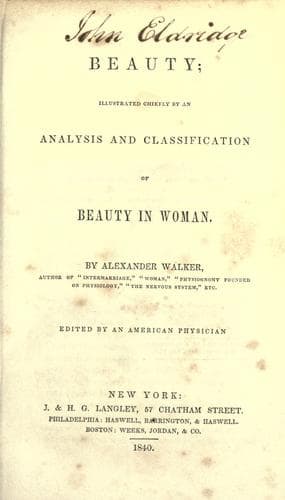
Beauty: Illustrated Chiefly by an Analysis and Classification of Beauty in WomanWalker, Alexander
Philosophy
Beauty: Illustrated Chiefly by an Analysis and Classification of Beauty in Woman
Walker, Alexander
Beauty, Personal; Women
For the same reason, united to a smaller foot, and some other
circumstances, women, it is observed, who execute gentle and light
movements with so much skill, do not attempt with advantage great
evolutions, run with difficulty and without grace, and fly--in order to be
caught, as Rousseau has said.
In woman, however, the muscular fibre is thus soft, yielding, feeble, and
incapable of great evolutions, because it is necessary that it should
easily adapt itself to remarkable changes.
From all this, from women having more address in the use of their fingers,
from their aptitude for little and light domestic works, the care of
children, and sedentary occupations, it is evident that they cannot devote
themselves to toilsome labors without struggling against their
organization, and suffering proportionally.
The voice being connected with the motive organs, it may here be noticed
that the larynx or flute part of the throat in woman is more contracted
and less prominent than in man; that the glottis does not enlarge in the
same proportion; that the tongue-bone is much smaller; and that the
tongue, its muscles, and the organs of speech in general, being, like all
the other parts, more mobile, young girls articulate and pronounce much
more quickly. Their voice is also so much more acute, that if man and
woman sing in unison, there is always between them the relation of an
octave, which forms the most natural and most agreeable consonance.
It is evidently the UNION of all that is good in these varieties which
renders beauty in the locomotive system perfect.
This is perfectly represented in the Diana of Grecian sculpture, in which,
with admirable taste, it is neither the nutritive nor the thinking, but
the locomotive system, which is developed.
* * * * *
I have already said, that the temperaments of the ancients are only
partial views of some of the varieties I am now describing. The _athletic
temperament_ falls under the _last of these varieties_; and it is the only
one that falls under this species. Happily, it does not occur in woman.
This temperament results from a great development of the bones and
muscles, and it is that of mere physical strength. It is marked by all the
outward signs of strength: the head is small, the neck thick behind, the
shoulders broad, the chest expanded, the haunches firm, the intervals of
the muscles deeply marked, the tendons apparent through the skin, and all
the joints not covered by muscles, seemingly small.
In this temperament, muscular strength prevails over the functions of the
other organs, and especially usurps the energies necessary to the
production of thought; the perceptions are deficient in quickness,
delicacy, accuracy, and strength; and all the mental functions are with
difficulty excited; but the body is capable of great exertion, and it
surmounts great physical resistance when roused.
Public-domain text, read in full here on John Shaqi.
Reviews
Reviews
No reviews yet
Be the first to share your thoughts on this work.
Elsewhere in the archive
Join the Discussion
Join the discussion
Sign in to leave a comment or review.
Sign InorCreate an account