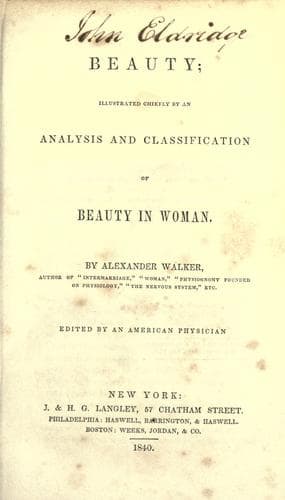
Beauty: Illustrated Chiefly by an Analysis and Classification of Beauty in WomanWalker, Alexander
Philosophy
Beauty: Illustrated Chiefly by an Analysis and Classification of Beauty in Woman
Walker, Alexander
Beauty, Personal; Women
Winckelmann observes that, in the antique statues, the mammæ terminate
gently in a point, and that they have always virginal forms, as a
consequence of the system of the ancient artists, which consists in not
recalling in the ideal the wants and the accidents of humanity.
Finally on this particular head, I must observe that the reproduction of
the species is, in woman, the most important object of life, and that
every thing in her physical organization has evident reference to it. Of
all the passions in woman, says Richerand, "love has the greatest sway: it
has even been said to be her only passion. All the others are modified by
it, and receive from it a peculiar cast, which distinguishes them from
those of man.... Fontenelle used to say of the devotion of some women,
'One may see that love has been here.' It has been said, in speaking of
St. Theresa, '_To love God, is still to love_.' Thomas maintains that,
'With women a man is more than a nation.'--'Love,' says Madame de Stael,
'is but an episode in the life of man; it is the whole history of the life
of woman.'"
The THIRD MODIFICATION, therefore, of this species of beauty, is that in
which the secreting vessels being active, not only cause the plumpness,
&c., necessary to beauty, but furnish the mammary and uterine secretions,
on which progeny is dependant. This must inevitably be followed by
moderate excretions.
It should not pass unobserved that there exist, in some women, a fair skin
and dark hair, forming a rather extraordinary and striking combination. As
such women have the skin remarkably smooth and moist, this is probably
connected with some peculiarity of secretion and excretion.
* * * * *
It is evidently the UNION of all that is good in these varieties which
renders beauty in the vital system perfect.
This union is nowhere so frequently to be seen, as in England and in
Holland.
It is curious that cleanliness among women seems necessarily to increase
with the development of this system; and that, in general slovenliness and
filth increase as we pass from England and Holland, toward France, Italy,
Spain, and Portugal, even among women of the highest condition.
* * * * *
Of the temperaments of the ancients, which, as already said, are only
partial views of some of the varieties I am now describing, two, the
_phlegmatic temperament_ and the _sanguine temperament_, appear to belong
fundamentally to _this species_. It has been supposed, that the first
affects the absorbent, the second the circulating system. They appear to
me to be exactly opposite affections of the whole nutritive system at
least.
The phlegmatic temperament may exist in both sexes. The causes which tend
to develop it, are infancy, humidity with cold, the absence of light,
indolence, and the feeble influence of the reproductive functions upon the
general system.
Public-domain text, read in full here on John Shaqi.
Reviews
Reviews
No reviews yet
Be the first to share your thoughts on this work.
Elsewhere in the archive
Join the Discussion
Join the discussion
Sign in to leave a comment or review.
Sign InorCreate an account