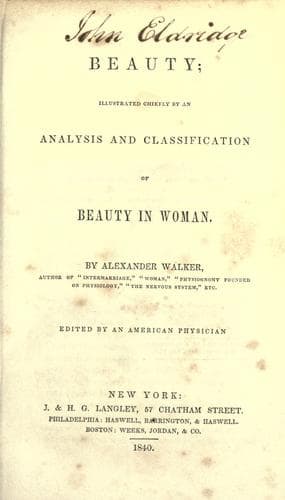
Beauty: Illustrated Chiefly by an Analysis and Classification of Beauty in WomanWalker, Alexander
Philosophy
Beauty: Illustrated Chiefly by an Analysis and Classification of Beauty in Woman
Walker, Alexander
Beauty, Personal; Women
When this organ, which is that of the will, is high, and more especially
when it is large, a determination and force seem to be given by it to the
character, which render it the reverse of feminine.
Having spoken here of the ready exercise of the will in woman, and its
adaptation to her wish to please, it seems to be here that some
circumstances dependant on these should be noticed.
With this ready exercise of the will and desire to please, are evidently
connected the light carelessness, the graceful ease, and the gentle
softness, which add so much to the power of beauty. Hence, artists give to
woman the bending form which associates so well with all her
characteristics; for all feel with Hogarth that undulating lines are more
or less formed in all movements executed with the intention of expressing
sentiments of courtesy, respect, benevolence, or love.
But it is grace that we must especially consider here--grace which
directly emanates from this ready exercise of the will and desire to
please, especially when combined with observing faculties so perfect and
so perpetually active as those of woman.
"Gracefulness," says Burke, "is an idea not very different from beauty; it
consists in much the same thing.... Gracefulness is an idea belonging to
posture and motion. In both these, to be graceful, it is requisite that
there be no appearance of difficulty; there is required a small inflexion
of the body; and a composure of the parts in such a manner, as not to
encumber each other, nor to appear divided by sharp and sudden angles. In
this ease, this roundness, this delicacy of attitude and motion, it is
that all the magic of grace consists, and what is called '_je ne scais
quoi_.'"
It is not in these mere physical qualities, that all the magic of grace
consists, which, in the state of Burke's knowledge, he might indeed well
call "_je ne scais quoi_!" Let the reader hear what is said on this
subject by a man who could look a little deeper than Burke, and who owed
no fame to the little art of substituting a flash of words for depth of
thought, and serving by it a venal purpose as little as the art itself.
Public-domain text, read in full here on John Shaqi.
Reviews
Reviews
No reviews yet
Be the first to share your thoughts on this work.
Elsewhere in the archive
Join the Discussion
Join the discussion
Sign in to leave a comment or review.
Sign InorCreate an account