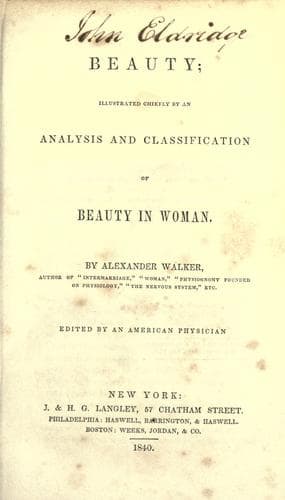
Beauty: Illustrated Chiefly by an Analysis and Classification of Beauty in WomanWalker, Alexander
Philosophy
Beauty: Illustrated Chiefly by an Analysis and Classification of Beauty in Woman
Walker, Alexander
Beauty, Personal; Women
A man standing upright, with his arms extended, is, as Leonardo da Vinci
has shown, enclosed in a square, the extreme extent of his arms being
equal to his height. This is evidently the most general measure of the
latter kind.
Of the latter kind, also, is Camper's ellipsis for measuring the relative
size of the shoulders in the male, and the pelvis in the female.
So also is the measure from the centre of one mammæ to that of the other,
as equal to the distance from each to the pit over the breast-bone.
We now approach the chief difficulty, which evidently formed a
stumbling-block even to Leonardo da Vinci--that HARMONIC METHOD which,
strange as it may appear, will be found to afford rules that are at once
perfectly _precise_, and yet infinitely _variable_. The apparent
impossibility indeed of such a rule seems to have embarrassed every one.
And the statement which Bossi makes in regard to Leonardo da Vinci, in
this respect, is exceedingly interesting.
"He thought," says Bossi, "but little of any general measure of the
species; and that _the true proportion_ admitted by him, and acknowledged
to be of difficult investigation, is solely _the proportion of an
individual in regard to himself_, which, according to true imitation,
should be _different in all the individuals of a species_, as is the case
in nature. Thus, says he, '_all the parts of any animal should correspond
with the whole_; that which is short and thick, should have every member
short and thick; that which is long and thin, every member long and thin;
and that which is between the two, members of a proportionate size.' From
this and other precepts, it follows, that, when he speaks of proportion,
he is to be understood as referring to the _harmony of the parts of an
individual_, and not to the general rule of imitation in reference to
dimensions."--How clearly (notwithstanding the error as to _all_ being
short and thick) does this point to the harmonic method of proportion
forthwith to be explained?
"It would seem he felt within himself that he did not reach the perfection
of those wonderful ancients of whom he professed himself the admirer and
disciple.
"It became, therefore, Leonardo's particular care and study to approach as
nearly as he could to the ancients in the true imitation of beautiful
nature under the guidance of philosophy.
"But whether from want of great examples, or from not sufficiently
penetrating, as he himself thought, into these artifices, or from
comprehending them too late, he modestly laments that he did not possess
the ancient art of proportions. He then protests that he has done the
little he was able to do, and asks pardon of posterity that he has not
done more. Such are the sentiments that Platino exhibits in the following
epitaph:
"Leonardus Vincia (sic) Florentinus
Statuarius Pictor que nobilissimus
de se parce loquitur.
Public-domain text, read in full here on John Shaqi.
Reviews
Reviews
No reviews yet
Be the first to share your thoughts on this work.
Elsewhere in the archive
Join the Discussion
Join the discussion
Sign in to leave a comment or review.
Sign InorCreate an account