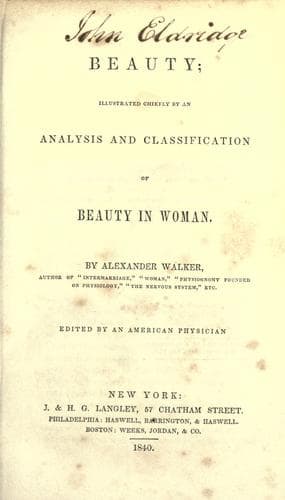
Beauty: Illustrated Chiefly by an Analysis and Classification of Beauty in WomanWalker, Alexander
Philosophy
Beauty: Illustrated Chiefly by an Analysis and Classification of Beauty in Woman
Walker, Alexander
Beauty, Personal; Women
Flaxman states that he himself had seen, in the stables of the Braschi
palace, a statue which he supposed might be the original work of
Praxiteles. Strange to tell, nothing is now known of its fate! A supposed
cast from this, or from a copy of it, conforming to the figure on the
model of Caracalla, is to be seen at the Royal Academy.
Of the VENUS DE MEDICI, Flaxman says, it "was so much a favorite of the
Greeks and Romans, that a hundred ancient repetitions of this statue have
been noticed by travellers. The individual figure is said to have been
found in the forum of Octavia. The style of sculpture seems to have been
later than Alexander the Great.
Let us now briefly examine this Model of Female Beauty.
The Venus de Medici represents woman at that age when every beauty has
just been perfected. "The Venus de Medici at Florence," says Winckelmann,
"is like a rose which, after a beautiful daybreak, expands its leaves to
the first ray of the sun, and represents that age when the limbs assume a
more finished form and the breast begins to develop itself."
The size of the head is sufficiently small to leave that predominance to
the vital organs in the chest, which, as already said, makes the nutritive
system peculiarly that of woman. This is the first and most striking proof
of the profound knowledge of the artist, the principles of whose art
taught him that the vast head, on the contrary, was the characteristic of
a very different female personage.[50]--In mentioning the head, it is
scarcely possible to avoid noticing the rich curls of the hair.
The eyes next fix our attention by their soft, sweet, and glad expression.
This is produced with exquisite art. To give softness, the ridges of the
eyebrows are rounded. To give sweetness, the under eyelid, which I would
call the expressive one, is slightly raised. "The eyes of Venus," says
Winckelmann, "are smaller, and the slight elevation of the lower eyelid
produces that languishing look called by the Greeks [Greek: hygron]." To
give the expression of gladness or of pleasure, the opening of the eyelids
is diminished, in order to diminish, or partially to exclude, the excess
of those impressions, which make even pleasure painful. Other exquisite
details about those eyes, confer on them unparalleled beauty. Still, as
observed by the same writer, this look is far from those traits
indicative of lasciviousness, with which some modern artists have thought
to characterize their Venuses. Love was considered by the ancient masters,
as by the wise philosophers of those times, to use the expression of
Euripides, as the counsellor of wisdom: [Greek: tê sophia paredrous
erôtas]. One thing must be observed: there is not here, as in some less
happy representations of Venus, any downcast look, but that aspect of
which Metastasio, in his Inno a Venere, says:
"Tu colle lucide
Pupille chiare,
Fai lieta e fertile
La terra e'l mare."
And again:
Public-domain text, read in full here on John Shaqi.
Reviews
Reviews
No reviews yet
Be the first to share your thoughts on this work.
Elsewhere in the archive
Join the Discussion
Join the discussion
Sign in to leave a comment or review.
Sign InorCreate an account