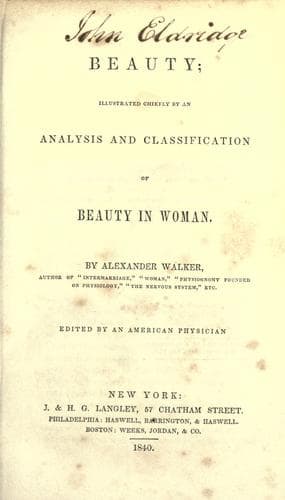
Beauty: Illustrated Chiefly by an Analysis and Classification of Beauty in WomanWalker, Alexander
Philosophy
Beauty: Illustrated Chiefly by an Analysis and Classification of Beauty in Woman
Walker, Alexander
Beauty, Personal; Women
The arms of the Venus de Medici, it should be observed, are of modern
construction, and unworthy of the figure.
The VENUS OF NAPLES is of altogether a different species of beauty.
That figure represents an ample and rather voluptuous matron, in an
attitude of scarcely surpassable grace. The character of the face is
beautiful, in profile especially, and its expression is grave. The mouth
has much of nature about it, resembling greatly in character that feature
as seen in Southern Europe; but its expression, though tender, is
somewhat serious or fretful.
It presents, however, many faults. The head is monstrous. The neck is
equally so, as well as coarse. The forehead, eyes, nose, and cheeks,
present none of the finely-calculated details, which surprise and delight
us in the Venus de Medici. The mammæ are not true.
After these, the androgynous being, called the VENUS OF ARLES, is scarcely
worthy of being mentioned. She derives some grandeur from antique
character and symmetry, and some from her masculine features. The head is
monstrous; the neck horrid; the nose heavy; the mouth contemptuous.
Upon the whole, neither the graceful matron of Naples, nor the manlike
woman of the Louvre, can be brought into competition with the Venus de
Medici.
CHAPTER XX.
DEFECTS OF BEAUTY.
_Defects of the Locomotive System._
1. If the whole figure be either too broad or too tall; because, the first
is inelegant, and the last unfeminine. Persons who are too tall are
generally ill at ease and destitute of grace, a greater misfortune to a
woman than to a man.--Too low a stature is a defect less disagreeable,
especially for women. If, however, on the one side, it gives prettiness,
on the other, it deprives of all imposing appearance.
2. If the bones, except those of the pelvis, be not proportionally small;
because, in woman, this portion of the locomotive system ought to be
completely subordinate to the vital.
3. If the ligaments, and the articulations they form, be not
proportionally small; because, in woman, this portion of the locomotive
system ought also to be completely subordinate to the vital.
Either of the last two defects will produce what is termed clumsiness.
4. If the muscles, generally more slender, feeble, soft and yielding than
in man, be not large around the pelvis, and delicate elsewhere; because,
this is necessary, for reasons which will be afterward assigned, as well
as to permit the ease and suppleness of the movements.
5. If, in a mature female, the length of the neck, compared with the
trunk, be not proportionally somewhat less than in the male; because, in
her, the subordination of the locomotive system, the predominance of the
vital, and the dependance of the mental, are naturally connected with the
shorter vertebrae and shorter course of the vessels of the neck.
* * * * *
Public-domain text, read in full here on John Shaqi.
Reviews
Reviews
No reviews yet
Be the first to share your thoughts on this work.
Elsewhere in the archive
Join the Discussion
Join the discussion
Sign in to leave a comment or review.
Sign InorCreate an account