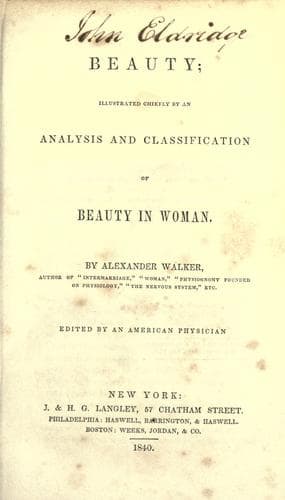
Beauty: Illustrated Chiefly by an Analysis and Classification of Beauty in WomanWalker, Alexander
Philosophy
Beauty: Illustrated Chiefly by an Analysis and Classification of Beauty in Woman
Walker, Alexander
Beauty, Personal; Women
Flaxman has truly said, that neither mind nor any one of its qualities or
powers, is an immediate object of perception to men. These are perceived
through the medium of material objects, on which their signatures are
impressed. The signs of these qualities are immediately perceived by the
senses, and by them reflected to the understanding; and we are apt to
attribute to the sign, the beauty which is properly and originally in the
thing signified. Thus, the invisible Creator hath stamped on his works
signatures of his divine wisdom, power, and benignity, which are visible
to all men. The works of men in science, in the arts of taste, and in the
mechanical arts, bear the signatures of those qualities of mind which were
employed in their production. Their external behavior or conduct in life,
expresses the good or bad qualities of their minds. In every species of
animals we perceive, by visible signs, their instincts, appetites,
affections, or sagacity; and even in the inanimate world, there are many
things analogous to the qualities of mind; so that there is hardly
anything belonging to mind which may not be represented by images taken
from objects of sense; and, on the other hand, every object of sense is
beautiful, by borrowing attire from attributes of the mind. Thus, the
beauties of mind, though invisible in themselves, are perceived in the
objects of sense, in which their beauty is impressed. Thus, also, in those
qualities of sensible objects to which we ascribe beauty, we discover in
them some relation to mind, and the greatest in those that are most
beautiful. Every beauty in the vegetable creation, of which we can form
any rational judgment, expresses some perfection in the object, or some
wise contrivance in the author. In the animal kingdom we perceive superior
beauties, resulting from life, sense, activity, various instincts and
affections, and, in many cases, great sagacity; which are attributes of
mind, and possess an original beauty. In their manner of life, we observe
that they possess powers, outward form, and inward structure, exactly
adapted to it; and the more perfectly any individual is fitted for its end
and manner of life, the greater is its beauty. This, also, was manifestly
Milton's theory of beauty; for, in his unrivalled description of our first
parents in Paradise, he derives their beauty from those expressions of
moral and intellectual qualities which shone forth in their outward form
and demeanor:--
"Two of far nobler shape, erect and tall,
God-like erect! with native honor clad,
In naked majesty, seemed lords of all,
And worthy seemed, for, in their looks divine,
The image of their glorious Maker, shone
Truth, wisdom, sanctitude, severe and pure;
Severe, but in true filial freedom placed,
Whence true authority in man; though both
Not equal, as their sex not equal seemed,
For contemplation he, and valor formed,
_For softness she, and sweet attractive grace_."
Public-domain text, read in full here on John Shaqi.
Reviews
Reviews
No reviews yet
Be the first to share your thoughts on this work.
Elsewhere in the archive
Join the Discussion
Join the discussion
Sign in to leave a comment or review.
Sign InorCreate an account