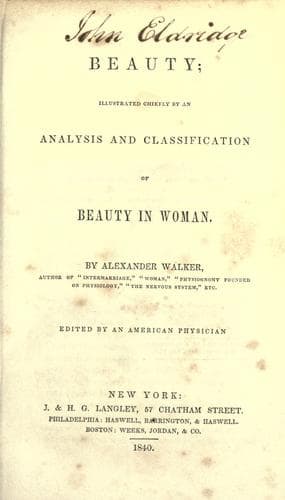
Beauty: Illustrated Chiefly by an Analysis and Classification of Beauty in WomanWalker, Alexander
Philosophy
Beauty: Illustrated Chiefly by an Analysis and Classification of Beauty in Woman
Walker, Alexander
Beauty, Personal; Women
"Sometimes, when the first impression has been rather unpleasing, a custom
has been acquired, because, afterward, it had been found pleasing or
advantageous. Thus there are many kinds of food, which were originally
ungrateful, but are now esteemed delicious. Port wine is nauseous for a
child, but it is pleasing to the taste of a person who has been accustomed
to it. Smoking, the taking of snuff, and masticating of tobacco, with many
other useless and dirty customs, are not produced by the pleasing
influence of novelty; but they are rather opposed to it. They arise
principally from the inclination of following injurious examples. In some
cases ladies have set their faces against such customs, and have
prohibited the practice among those who would gain their esteem: in other
cases they have been more lenient, because they have found that a flame of
love may burn amid volumes of smoke from cigars or tobacco-pipes. Novelty
has occasioned a sensation of unpleasantness, with regard to particular
modes of dress; but afterward these fashions have become necessary to our
comfort.
"In some instances, the very things which we commonly hate most, become
essential to our happiness. When Louis XVI. ascended the throne of France,
the doors of some of the dark cells in the Bastile were opened, and the
hapless residents were allowed once more to breathe the pure air of
heaven. Among the rest, there was one man who had been immured for nearly
fifty years in a wretched cell, the area of which was so small as scarcely
to allow him room to move about; but, having a vigorous body and a firm
mind, he supported himself, until he had almost forgotten the world in
which he lived, having had no intercourse with any one but the jailer, who
brought him his daily food. When he received the summons to depart, which
seemed like a message in a dream, he was astonished; but when he walked
through the spacious passages and the open courts, and saw the heavens
extended above him, and the sun shining in his splendor, he was overcome
by his feelings. He could badly walk, and badly speak, and he seemed as if
he had entered a new world. He went into the city, and found the street in
which he had formerly lived, but his friends were dead; there was no
living being in the world that knew him, and the poor man wept with
sorrow. He was a stranger in a strange country. He went to the minister
who had given him his freedom, and said: 'Sir, I can bear to die, but to
live in a world unknown and forlorn, the last human being of my race, is
insupportable; do, therefore, send me to my cell, that I may finish my
days there!' No blessing of Providence will be felt as a benefit, unless
it be possessed by a person for whom it is adapted.
Public-domain text, read in full here on John Shaqi.
Reviews
Reviews
No reviews yet
Be the first to share your thoughts on this work.
Elsewhere in the archive
Join the Discussion
Join the discussion
Sign in to leave a comment or review.
Sign InorCreate an account