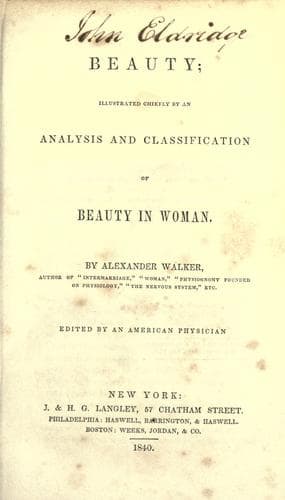
Beauty: Illustrated Chiefly by an Analysis and Classification of Beauty in WomanWalker, Alexander
Philosophy
Beauty: Illustrated Chiefly by an Analysis and Classification of Beauty in Woman
Walker, Alexander
Beauty, Personal; Women
Mr. Walker, in various places of his work, calls the _cerebel_ or
cerebellum, "the organ of volition," and, at page 145, he attributes
ideas, emotions, and passions, to the cerebrum, though he states that acts
of the will result from these. Now, if there is any truth established, it
is that the _will_ is the result of the simultaneous action of the higher
intellectual powers, and supposes attention, reflection, comparison, and
judgment, mental operations, which Mr. Walker himself attributes to the
cerebrum. Gall has made it very evident, that the _will_ is not the
impulse that results from the activity of a single organ, but the
concurrent action of many of the higher intellectual faculties--motives
must be weighed, compared, and judged, before there can be any will, or
determination of mind. The decision resulting from this determination, is
called will. We consider it then proved, that there is no particular organ
of the will. "Every fundamental faculty," says Dr. Gall, "accompanied by a
clear notion of its existence, and by reflection, is intellect or
intelligence. Each individual intelligence, therefore, has its proper
organ; but reason supposes the concerted action of the higher faculties.
It is the judgment pronounced by the higher intellectual faculties. A
single one of these, however, could not constitute reason, which is the
compliment, the result of the simultaneous action of all the intellectual
faculties. It is _reason_ that distinguishes man from the brute;
_intellect_ they have in common to a certain degree. There are many
intelligent men, but few reasoning ones. Nature produces an intelligent
man; a happy organization, cultivated by experience and reflection, forms
the reasoning man." Nearly all physiologists deserving of the name, are
now united in the opinion that the cerebellum is the organ of amativeness,
as well as concerned in the regulation of voluntary motion. "It is
impossible," says Dr. Spurzheim, "to unite a greater number of proofs in
demonstration of any natural truth than may be presented to determine the
function of the cerebellum."--"Mr. Scott," says George Combe, "in an
excellent essay on the influence of amativeness on the higher sentiments
and intellect, observes that it has been regarded by some individuals, as
almost synonymous with pollution; and the notion has been entertained,
that it cannot be even approached without defilement. This mistake has
originated from attention being directed too exclusively to the abuses of
the propensity. Like everything that forms part of the system of nature,
it bears the stamp of wisdom and excellence in itself, although liable to
abuse. It exerts a quiet but effectual influence in the general
intercourse between the sexes, giving rise in each to a sort of kindly
interest in all concerns the other. This disposition to mutual kindness
between the sexes, does not arise from benevolence or adhesiveness, or any
Public-domain text, read in full here on John Shaqi.
Reviews
Reviews
No reviews yet
Be the first to share your thoughts on this work.
Elsewhere in the archive
Join the Discussion
Join the discussion
Sign in to leave a comment or review.
Sign InorCreate an account