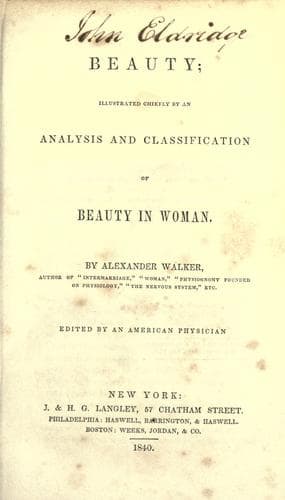
Beauty: Illustrated Chiefly by an Analysis and Classification of Beauty in WomanWalker, Alexander
Philosophy
Beauty: Illustrated Chiefly by an Analysis and Classification of Beauty in Woman
Walker, Alexander
Beauty, Personal; Women
The _larynx_ is one of the organs which presents most manifestly the
differences of sex. That of the female is usually one third, and sometimes
one half smaller than that of the male: all its constituent cartilages are
much thinner; the thyroid cartilage also is even flatter, because its two
lateral halves unite at a less acute angle. Hence the reason why the
larynx in the male forms at the upper part of the neck a prominence which
is not visible in the female. The glottis in the female is much smaller
than in the male, and the vocal cords are shorter. These sexual
differences do not appear till puberty; until then the larynx has
precisely the same form in the two sexes, and consequently the voice is
nearly the same in both. In eunuchs it is small as in females.
PHYSIOLOGICAL EXPLANATION OF THE BEAUTY OF FORM.
A very ingenious Physiological explanation of the beauty of form, has been
suggested by Professor B. T. Joslin, of the University of the city of New
York, which is published in the Transactions of the New York State Medical
Society for 1836. As this theory is characterized by great originality and
genius, and but little known, we shall present our readers with some
extracts from the Essay, calculated to elucidate the views of the talented
author.
Speaking of material objects, not including the human form, Dr. J.
remarks:--
"There is in objects a kind of beauty which is intrinsic and physical,
which belongs to them in every association, and whether at rest or in
motion; such is the beauty of color, and that of configuration. The
contemplation of the beauty of coloring and of form gives physical
pleasure, i. e., physical as opposed to mental, but physiological as
opposed to physical. Employing physical in its comprehensive sense, I say
that this physical pleasure attending vision is of two distinct kinds;
1st, that which depends on the character of the impression on the retina,
and consequently on the intensity and nature of the light; and 2dly, that
which depends upon the form of the object, and, consequently, on the
muscular actions employed in tracing its outlines. As the latter
constitutes the proper subject of this essay, I shall dismiss the former
with a single remark.
Public-domain text, read in full here on John Shaqi.
Reviews
Reviews
No reviews yet
Be the first to share your thoughts on this work.
Elsewhere in the archive
Join the Discussion
Join the discussion
Sign in to leave a comment or review.
Sign InorCreate an account