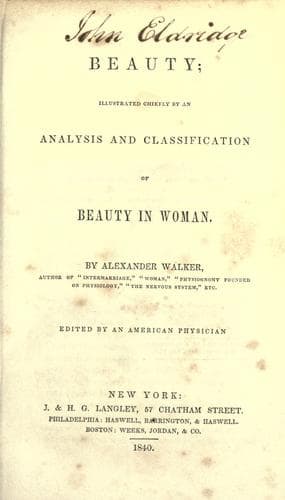
Beauty: Illustrated Chiefly by an Analysis and Classification of Beauty in WomanWalker, Alexander
Philosophy
Beauty: Illustrated Chiefly by an Analysis and Classification of Beauty in Woman
Walker, Alexander
Beauty, Personal; Women
"The foregoing statements of general principles preclude the necessity of
minute details in relation to particular curves. I shall at present
consider those which do not return into themselves, so as to constitute
the outlines of figures in the geometrical sense. Let us first select a
semi-circumference, for example, that of a rainbow of maximum dimensions.
In tracing it once, we employ three out of the four muscles. They are
brought into action successively and rapidly, but not abruptly. All these
circumstances are favorable to pleasure. Yet they are not conducive to it
in the highest possible degree; for each muscle acts only once unless the
examination be repeated; and in case of its repetition, the momentum of
the eyeball is destroyed in stopping and reversing its motion. The waving
line, as Hogarth's line of beauty, obviates the first difficulty. This
ensures not only the successive action of different muscles, but a
repetition of action in the same. If the line forms a number of equal
waves, these repetitions will be proportional to the number of waves, and
will alternately and totally relieve, at least two muscles, and allow, in
the action of a third, regular remissions of intensity at equal intervals.
We have proved then, that on this physiological theory, a
semi-circumference possesses more of the elements of beauty than any
straight line, and a regular-waved line more than either. These results
are conformable to experience. If there is any difficulty in admitting
this, it will vanish on comparing the ocular with other muscles.
"Let us select a joint, which, in its spherical form, and the circular
arrangement of its muscles, is analogous to the eye; for example, the
shoulder joint. I think it will be uniformly found, that in the use of
this joint, the curves most readily traced, are those of gentle and nearly
equal curvature, and being such as are most easily traced by the eye, they
would appear more beautiful than those drawn by the fingers with the same
education. For example, let a man, without bending his wrist or elbow,
draw various lines with a light stick or cane on the surface of snow: the
lines most easily drawn (or most easily traced if already drawn), will be
curves of considerable beauty, and nearly equal curvature; such as waved
lines and spirals and looped curves. Circles and ellipses would also be
among the figures with most facility and precision traced, and especially
in cases of repeated tracing; but we are not at present considering
figures in the proper geometrical sense of the term. In writing letters by
the above method, a succession of 'e's, would be more readily drawn than a
succession of 'i's, or a zigzag line with acute angles.
Public-domain text, read in full here on John Shaqi.
Reviews
Reviews
No reviews yet
Be the first to share your thoughts on this work.
Elsewhere in the archive
Join the Discussion
Join the discussion
Sign in to leave a comment or review.
Sign InorCreate an account