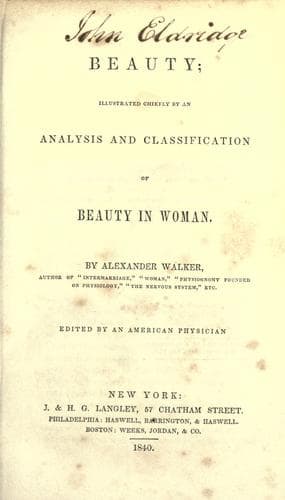
Beauty: Illustrated Chiefly by an Analysis and Classification of Beauty in WomanWalker, Alexander
Philosophy
Beauty: Illustrated Chiefly by an Analysis and Classification of Beauty in Woman
Walker, Alexander
Beauty, Personal; Women
"_Symmetry of form_, though implied in geometrical regularity, is not
identical with it, and requires a separate consideration. The beauty of
forms geometrically symmetrical, in contradistinction from those
deficient in the correspondence of opposite halves, depends upon two
similar series of actions in different pairs or muscles. For example, the
survey of an ovate leaf, or indeed that of almost any vegetable leaf--so
numerous are the provisions for our gratification--requires for its
opposite halves two series of muscular actions, the different parts of the
one corresponding with those of the other in duration, intensity, and
order of succession. The gratification in this case results from the
harmony of muscular sensations individually pleasurable. The agreeableness
of this harmony may depend upon a principle more psychological than that
of the agreeableness of its elementary sensations. Yet the former is to a
certain extent susceptible of a physiological generalization. This harmony
would probably have been impaired by any considerable inequality in the
distances between the points of insertion of the recti muscles, or in the
strength of the antagonists. It is a curious coincidence, that in both
these respects, these muscles are more nearly symmetrical than any others
in the human body. Physiology, then, explains, not only the agreeableness
of the elementary sensations, which give rise to the perception of beauty
in regular curves, but unfolds the provisions for two similar series of
such sensations, not only in figures simply regular, but in those which
are simply symmetrical, and in those which are both symmetrical and
regular. The principles of muscular action explain the agreeableness of a
rapid succession of varied actions equally distributed among the muscles,
and the structure of the optical apparatus explains why the curvature and
regularity of an object require such actions in vision. Again, we discover
in the symmetrical structure and arrangement of the ocular muscles, a
provision for two similar series of pleasurable sensations in the survey
of a symmetrical figure, in whatever position it may be placed, provided
it retains its symmetry with respect to some visual plane. The coincidence
between the location of the ocular muscles diametrically opposite, on the
one hand, and our propensity to compare the opposite halves of bodies, and
the pleasure afforded by their similarity on the other hand, is curious,
and to a certain extent affords a physiological explanation of the beauty
of symmetrical forms.
"The same principles which apply to the beauty of form of inanimate
objects are applicable to the paths described by them in _motion_. The
intrinsic beauty of their motions is exclusively referrible to sensations
in the ocular muscles of the observer, while the gracefulness of human
motions is referrible in part to these, and in part to sensations in other
muscles.
Public-domain text, read in full here on John Shaqi.
Reviews
Reviews
No reviews yet
Be the first to share your thoughts on this work.
Elsewhere in the archive
Join the Discussion
Join the discussion
Sign in to leave a comment or review.
Sign InorCreate an account