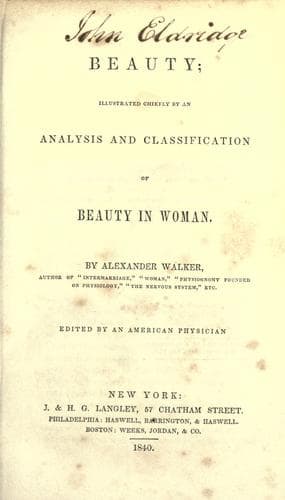
Beauty: Illustrated Chiefly by an Analysis and Classification of Beauty in WomanWalker, Alexander
Philosophy
Beauty: Illustrated Chiefly by an Analysis and Classification of Beauty in Woman
Walker, Alexander
Beauty, Personal; Women
"This application to natural theology, has thus far had reference to that
degree of intrinsic agreeableness which is common to forms in general. But
the laws of nature specially tend to the production of curved, regular,
and symmetrical objects and motions, in inorganic vegetable and animal
bodies; and impose the necessity of similar forms in artificial
structures. With a different structure and arrangement of the ocular
muscles, those forms peculiarly conducive to our welfare and that of the
universe, had possessed no peculiar attractions; and we had felt no
special impulse of this kind to conform our own artificial structures to
those laws of nature, or to investigate many of the most important works
of the Creator. Yet neither gravity or any other law of the external world
could have determined the peculiar formation of the muscles of the human
eye. We must, therefore, refer their actual structure and location to
that Being who gives to the objects of his creative power, and to the
principles by which he governs them, such a mutual adaptation as conduces
to the greatest achievable good. Thus, while muscular pleasure originally
prompts to the observation of the Creator's works, this observation is
rewarded and subsequently prompted by a pleasure of an incomparably higher
order, of a character purely mental, by the discovery of _moral beauty_,
which in rank and refinement surpasses all others. Still, the muscular
pleasure of the eye strongly incites to the examination of the numberless
forms of beauty in the organic and inorganic kingdoms, such as the
symmetrical leaf, the bending bough, the symmetry of the tree itself that
of inferior animals, and of the human form. Or we may extend our view to
the circular or undulating horizon, the apparent limits of the apparently
round world; or we may elevate the eyes to the arched dome of the
firmament, on which the arches of the iris and aurora occasionally confer
additional beauty. Or with the telescope we may pierce this apparent limit
of upward vision, and discover beyond it a universe of spherical and
spheroidal worlds, revolving in circular and elliptical orbits, worlds and
orbits which present, even in our diminutive diagrams, a high order of
beauty, designed to incite us to the contemplation of these most
magnificent works of the Creator.
Public-domain text, read in full here on John Shaqi.
Reviews
Reviews
No reviews yet
Be the first to share your thoughts on this work.
Elsewhere in the archive
Join the Discussion
Join the discussion
Sign in to leave a comment or review.
Sign InorCreate an account