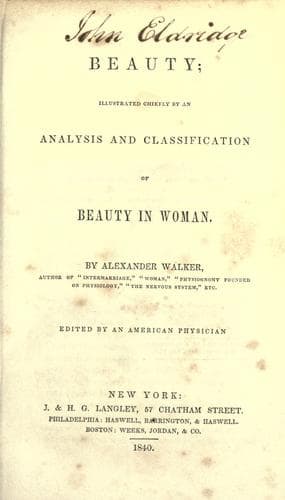
Beauty: Illustrated Chiefly by an Analysis and Classification of Beauty in WomanWalker, Alexander
Philosophy
Beauty: Illustrated Chiefly by an Analysis and Classification of Beauty in Woman
Walker, Alexander
Beauty, Personal; Women
polish the manners of society, and to contribute to its order and
happiness."
F.
TEMPERAMENT.
The views of Mr. Walker in relation to Temperaments, correspond with those
usually entertained by physiological writers. It is to be observed,
however, that they rarely occur simple in any individual, two or more
being generally combined. The _bilious_ and _nervous_, for example, is a
common combination, which gives strength and activity; the _lymphatic_ and
_nervous_, is also common, and produces sensitive delicacy of mental
constitution, conjoined with indolence. The _nervous_ and _sanguine_
combined, give extreme vivacity, but without corresponding vigor. Dr.
Thomas of Paris, has advanced the following theory of the temperaments:
When the digestive organs, filling the abdominal cavity, are large, and
the lungs and brain small, the individual is _lymphatic_; he is fond of
feeding, and averse to mental and muscular exertion. When the heart and
lungs are large, and the brain and abdomen small, the individual is
_sanguine_; blood abounds, and is propelled with vigor; he is therefore
fond of muscular exercise, but averse to thought. When the brain is large,
and the abdominal and thoracic viscera small, great mental energy is the
consequence. These proportions may be combined in great varieties, and
modified results will ensue.[59] Mr. Combe, in his late lectures in this
city, laid great stress on the relative size of the three great visceral
cavities, in determining the temperament. Thus, if the abdominal and
thoracic cavities be small, and the cranial cavity large, the _nervous_
temperament is indicated. If the abdomen and scull be comparatively small,
and the chest large, the sanguine temperament is indicated. The
predominance of the abdominal cavity indicates the lymphatic temperament.
Mr. C. also pointed out the important changes produced in the temperament
by a long continued course of training. It is common for the bilious, to
be changed into the nervous temperament, by habits of mental activity, and
close study; and, on the other hand, we often see the nervous or bilious
changed into the lymphatic about the age of 40, when the nutritive system
seems to acquire the preponderance. Spurzheim used to say, that he had
originally a large portion of the lymphatic temperament, as had all his
family; but that in himself the lymphatic had gradually diminished, and
the nervous gradually increased; whereas, in his sisters, owing to mental
inactivity, the reverse had happened, and when he visited them, after
being absent many years, he found them, to use his own expression, "_as
large as tuns_." The subject of temperament has been treated with
consummate ability by Dr. Charles Caldwell of Kentucky; and as his essay
is but little known, we shall present some extracts from it. It will be
seen that his views bear a close resemblance to those of Dr. Thomas,
already mentioned; but Dr. C. has shown that they were publicly maintained
Public-domain text, read in full here on John Shaqi.
Reviews
Reviews
No reviews yet
Be the first to share your thoughts on this work.
Elsewhere in the archive
Join the Discussion
Join the discussion
Sign in to leave a comment or review.
Sign InorCreate an account