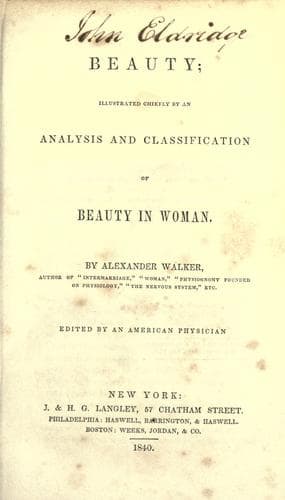
Beauty: Illustrated Chiefly by an Analysis and Classification of Beauty in WomanWalker, Alexander
Philosophy
Beauty: Illustrated Chiefly by an Analysis and Classification of Beauty in Woman
Walker, Alexander
Beauty, Personal; Women
"This subject may be farther illustrated by a reference to some of the
animals below us. The worm commonly denominated a grub is but little else
than a mass of abdominal matter. It is therefore one of the humblest and
grossest of worms. The insect has also a large abdomen, with a very small
chest, and a smaller head. Hence, though superior to the grub, it is low
in the scale of animal nature. Reptiles and fish are more elevated,
because their abdominal viscera preponderate less. But still they do
preponderate; and therefore the rank of the animals is humble. In the hog
the abdominal viscera are most strongly developed, and hence his standing
among quadrupeds is low. The same is true of the bear and the ox, and also
of the sheep and the goat, but in an inferior degree. The horse,
especially the barb and the racehorse, furnish no bad specimens of the
mixed or balanced temperament. When the latter is undergoing preparation
for the course, the object of his keeper is to make the thoracic
temperament preponderate as much as possible, for the time, in order to
increase his vigor and endurance; in the language of the turf, to give him
more strength and 'better bottom.' The warhorse approaches the thoracic
temperament. In the canine race, more especially in the greyhound, the
thoracic viscera hold the ascendency. Hence the muscular power of the dog
is greater, and his grade among quadrupeds higher than those of most of
the preceding animals. The same is true of the wolf, the panther, and the
tiger. In some dogs there is a considerable cerebral development, but it
is never large enough to counterbalance the thoracic. Of all animals, the
lion affords the most finished specimen of thoracic preponderance. In
proportion to his size, his lungs and heart, especially the latter, are
immensely large. And his muscular power corresponds to them. The magnitude
of his heart is generally considered the cause of his boldness. Hence a
very courageous man is said to have a _great_ heart, or to be
_lion-hearted_. All this is popular error. The heart is but a muscle; and,
in man, has no more connexion with courage than the gastrocnemii muscles;
nor, in the lion, than the muscles that move his tail. Courage is
exclusively a cerebral attribute, and has its seat in an organ
specifically appropriated to it. In none of the inferior animals does the
brain preponderate. That preponderance belongs to humanity, and, as
already mentioned, indicates its highest grade. Of all the beings below
us, some of the ape tribe have the highest cerebral development. And they
approach nearest to man in their degree of intellect. This is farther
proof that, other things being alike, the brain gives the measure of
mental power. I have lately seen a publication, in which it is gravely
asserted, that the large orang-outang catches crabs with a stick, and
makes a rude basket of osiers to contain them. Notwithstanding the
well-known sagacity of that animal, this statement savors strongly of the
Public-domain text, read in full here on John Shaqi.
Reviews
Reviews
No reviews yet
Be the first to share your thoughts on this work.
Elsewhere in the archive
Join the Discussion
Join the discussion
Sign in to leave a comment or review.
Sign InorCreate an account