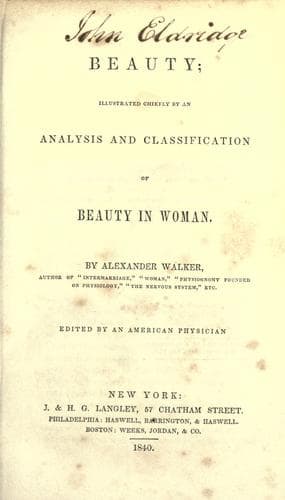
Beauty: Illustrated Chiefly by an Analysis and Classification of Beauty in WomanWalker, Alexander
Philosophy
Beauty: Illustrated Chiefly by an Analysis and Classification of Beauty in Woman
Walker, Alexander
Beauty, Personal; Women
"4. _The abdominal._ This temperament is easily recognised by the
character it imparts to the person and intellect. The pelvis is broad in
proportion to the shoulders and thorax, the abdomen large and prominent,
and the adipose matter abundant, filling up the interstices of the
muscles, and often forming a layer between them and the skin, in
consequence of which the limbs are round and smooth and soft to the touch.
In such constitutions, ecchymosis succeeds with unusual readiness, to
slight contusions. Circulation in the skin being feeble, the complexion
may be fair and delicate, but never very ruddy or strong. The size of the
head is limited, the intellectual moderate, the eye deficient in lustre
and the countenance in expression, and the movements heavy and seldom
graceful. The abdominal viscera seem to draw everything into the vortex of
their action. The amount of vitality is evidently below its common measure
in the human system, and, in some instances, the flesh seems to hang as a
load on the spirit."
"5. _The encephalo-thoracic._ This temperament is a type of power both
bodily and mental. Its compound name expresses fully the external
appearances that mark it, as well as the attributes that always accompany
them. With an abdomen of moderate dimensions, the head of the individual
who possesses it is large and vigorous to conceive and direct, and his
chest and muscles powerful to execute, and hardy to endure. It is the
temperament of masculine and comprehensive thought and strong propensity,
united to energetic action, rather than of seclusion and profound
meditation. As in all other cases, the character is varied in it according
to the portion of the brain that is most largely developed. He to whom it
belongs feels himself in his proper sphere when he is among men, and is
well fitted to act his part in times of tumult and scenes of difficulty.
Is his brain large in each of its compartments? If an occasion present
itself, he not only mingles in the moral storm, but aspires to direct it.
In case of his becoming a warrior, his genius and sword are alike
formidable. In battle, previously to the invention of fire-arms, such a
man was the terror of his enemies and the hope of his friends. Ulysses, as
sketched by Homer, is as fairly the _beau ideal_ of this temperament, as
Hercules is of the thoracic. That chieftain was alike wise to counsel,
intrepid to dare, and powerful to perform. Plato, so called from the
uncommon breadth of his chest, who had also a very large head, is another
excellent model of the same. Even in times of peace the corporeal
attributes of a man of this description add to his influence. Jupiter, the
emblem of wisdom and power, as represented by the ancient statuaries, with
an immense head and trunk, and arms of matchless strength, is as finished
a specimen of the encephalo-thoracic temperament, as Apollo is of the
mixed."
Public-domain text, read in full here on John Shaqi.
Reviews
Reviews
No reviews yet
Be the first to share your thoughts on this work.
Elsewhere in the archive
Join the Discussion
Join the discussion
Sign in to leave a comment or review.
Sign InorCreate an account