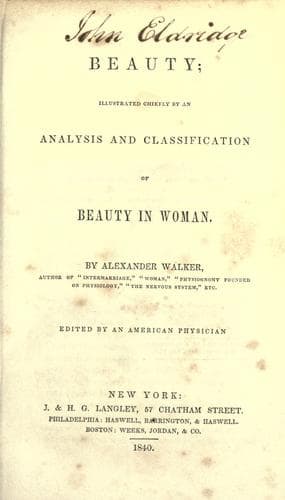
Beauty: Illustrated Chiefly by an Analysis and Classification of Beauty in WomanWalker, Alexander
Philosophy
Beauty: Illustrated Chiefly by an Analysis and Classification of Beauty in Woman
Walker, Alexander
Beauty, Personal; Women
[31] The cause of this has never been explained; and it could not well be
explained, without a perception of the views in my preceding physiological
arrangement.--The brain, at this period, becomes more subservient to
purposes connected with generation; the communication between the trunk
and the head is more frequent, intense, and sustained; and the neck, which
contains the communicating organs, necessarily increases in size. This
unexplained circumstance led to the mistake of the craniologists
respecting the cerebel. Here, therefore, as in other cases pointed out in
my work on Physiognomy, Gall and Spurzheim ascribe to deeper-seated organs
what belongs to more superficial ones.
[32] Appendix F.
[33] Appendix G.
[34] Memoire sur le Beau Physique.
[35] A curious but true remark is made by Moreau, namely, that if these
conditions are met with without being united to a certain expression, and
to the most complete combination of the elements of beauty of countenance,
they frequently give an air of insensibility and of mental weakness, which
greatly enfeebles the impression that a first view had caused.
[36] Statistical results in relation to the supply of hospitals and
prisons, carry the expense of a man much beyond that of a woman.
[37] Appendix H.
[38] Appendix I.
[39] See the causes of this explained in my work on "Physiognomy."
[40] Pallas--Voyages en Siberie.
[41] Humboldt's Political Essay on the Kingdom of New Spain.
[42] It is remarkable that, in infants, the nose is almost always flat,
and that, in some members of the same family, it always remains so, while,
in others, it rises. This is attended by difference of function.
[43] "Physiognomy founded on Physiology, and applied to various Countries,
Professions, and Individuals: with an Appendix on the Bones at Hythe--the
Sculls of the ancient Inhabitants of Britain, and its Invaders:
illustrated by Engravings."--Smith, Elder, & Co., Cornhill.
[44] Of the best works on this subject, those of Mengs alone, I believe,
have been translated; but the translation is so inaccurate as to be
worthless.
[45] Thus it is not correct, as stated by Leonardo, that when some parts
are broad or thick, all are broad; though, in peculiar combinations, that
may occur.
[46] Lib. II. in Timæum Platonis.
[47] This member of the Royal Academy was suspected of having written that
"republics had done more for the advancement of the fine arts than
monarchies." The late George III., who did not approve of truths of that
kind, was thereby so much enraged, that he instantly sent for the list of
the members of the academy, and therefrom erased the name of Barry. The
academicians humbly submitted to the indignity which hereditary wisdom
thus inflicted. It would appear, however, that bad principles are
spreading among the Royal academicians; for the works of this expelled
member are now daringly given by them as a prize to students at the
academy!
Public-domain text, read in full here on John Shaqi.
Reviews
Reviews
No reviews yet
Be the first to share your thoughts on this work.
Elsewhere in the archive
Join the Discussion
Join the discussion
Sign in to leave a comment or review.
Sign InorCreate an account