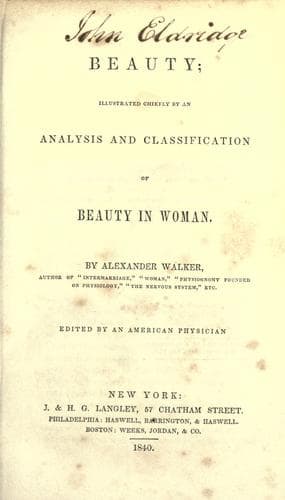
Beauty: Illustrated Chiefly by an Analysis and Classification of Beauty in Woman — John Shaqi
Beauty: Illustrated Chiefly by an Analysis and Classification of Beauty in WomanWalker, Alexander
Philosophy
Beauty: Illustrated Chiefly by an Analysis and Classification of Beauty in Woman
Walker, Alexander
Beauty, Personal; Women
"In these nice cases, supposing the acuteness of the sense equal, the
greater attention and habit in such things will have the advantage. In the
question about the tables, the marble-polisher will unquestionably
determine the most accurately.
"In the imagination, beside the pain or pleasure arising from the
properties of the natural object, a pleasure is perceived from the
resemblance which the imitation has to the original.
"All men are nearly equal in this point, as far as their knowledge of the
things represented or compared extends.
"The principle of this knowledge is very much accidental, as it depends
upon experience and observation, and not on the strength or weakness of
any natural faculty; and it is from this difference in knowledge that what
we commonly, though with no great exactness, call a difference in taste,
proceeds.
"A man to whom sculpture is new sees a barber's block, or some ordinary
piece of statuary; he is immediately struck and pleased, because he sees
something like a human figure; and entirely taken up with this likeness,
he does not at all attend to its defects. No person, I believe, at the
first time of seeing a piece of imitation, ever did. Some time after, we
suppose that this novice lights upon a more artificial work of the same
nature; he begins to look with contempt on what he admired at first; not
that he admired it even then for its unlikeness to a man, but for that
general though inaccurate resemblance which it bore to the human figure.
What he admired at different times in these so different figures, is
strictly the same; and though his knowledge is improved, his taste is not
altered. Hitherto his mistake was from a want of knowledge in art, and
this arose from his inexperience; but he may be still deficient, from a
want of knowledge in nature. For it is possible that the man in question
may stop here, and that the masterpiece of a great hand may please him no
more than the middling performance of a vulgar artist; and this not for
want of better or higher relish, but because all men do not observe with
sufficient accuracy on the human figure, to enable them to judge properly
of an imitation of it."
On other points, Hume makes the following observations:--
"Without being frequently obliged to form _comparisons_ between the
several species and degrees of excellence, and estimating their proportion
to each other ... a man is indeed totally unqualified to pronounce an
opinion with regard to any object presented to him. By comparison alone,
we fix the epithets of praise or blame, and learn how to assign the due
degree of each.
"But to enable a critic more fully to execute this undertaking, he must
preserve his mind free from all _prejudice_ and allow nothing to enter
into his consideration, but the very object which is submitted to his
examination.
Public-domain text, read in full here on John Shaqi.
Reviews
Reviews
No reviews yet
Be the first to share your thoughts on this work.
Join the Discussion
Join the discussion
Sign in to leave a comment or review.
Sign InorCreate an account