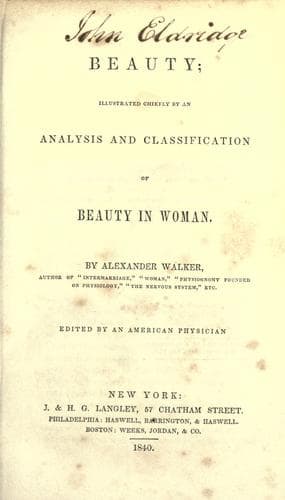
Beauty: Illustrated Chiefly by an Analysis and Classification of Beauty in WomanWalker, Alexander
Philosophy
Beauty: Illustrated Chiefly by an Analysis and Classification of Beauty in Woman
Walker, Alexander
Beauty, Personal; Women
"It is well known, that, in all questions submitted to the understanding,
prejudice is destructive of sound judgment, and perverts all operations of
the intellectual faculties: it is no less contrary to good taste; nor has
it less influence to corrupt our sentiments of beauty. It belongs to _good
sense_ to check its influence in both cases; and in this respect, as well
as in many others, reason, if not an essential part of taste, is at least
requisite to the operations of this latter faculty. In all the nobler
productions of genius, there is a mutual relation and correspondence of
parts; nor can either the beauties or blemishes be perceived by him whose
thought is not capacious enough to comprehend all those parts, and compare
them with each other, in order to perceive the consistence and uniformity
of the whole. Every work of art has also a certain end or purpose for
which it is calculated; and is to be deemed more or less perfect, as it is
more or less fitted to attain this end."
To a repetition of this, Burke adds some useful remarks:--
"As many of the works of imagination are not confined to representation of
sensible objects, nor to efforts upon the passions, but extend themselves
to the manners, the characters, the actions, and designs of men, their
relations, their virtues and vices, they come within the province of the
judgment, which is improved by attention and by the habit of reasoning.
"The cause of a wrong taste is a defect of judgment. And this may arise
from a natural weakness of understanding (in whatever the strength of
that faculty may consist), or which is much more commonly the case, it
may arise from a want of proper and well-directed exercise, which alone
can make it strong and ready. Beside that ignorance, inattention,
prejudice, rashness, levity, obstinacy, in short, all those passions, and
all those vices which pervert the judgment in other matters, prejudice it
no less in this its more refined and elegant province. These causes
produce different opinions upon everything which is an object of the
understanding, without inducing us to suppose, that there are no settled
principles of reason.
"A rectitude of judgment in the arts, which may be called a good taste,
does in a great measure depend upon sensibility; because, if the mind has
no bent to the pleasures of the imagination, it will never apply itself
sufficiently to works of that species to acquire a competent knowledge in
them. But though a degree of sensibility is requisite to form a good
judgment, yet a good judgment does not necessarily arise from a quick
sensibility of pleasure; it frequently happens that a very poor judge,
merely by force of a greater complexional sensibility, is more affected by
a poor piece, than the best judge by the most perfect; for as everything
new, extraordinary, grand, or passionate, is well calculated to affect
such a person, and that the faults do not affect him, his pleasure is more
pure and unmixed.
Public-domain text, read in full here on John Shaqi.
Reviews
Reviews
No reviews yet
Be the first to share your thoughts on this work.
Join the Discussion
Join the discussion
Sign in to leave a comment or review.
Sign InorCreate an account